Flashes and Floaters: Emergency Eye Doctor Fort Collins, CO
Direct Answer: If you are experiencing a sudden shower of new floaters, flashes of light in your peripheral vision, or a shadow moving across your sight, you need to see an emergency eye doctor today — not tomorrow. While most floaters are harmless, these specific warning signs can indicate a retinal tear or detachment, a sight-threatening emergency requiring immediate evaluation. In Fort Collins, CO, Poudre Valley Eyecare provides urgent retinal imaging using Optomap technology to diagnose and triage these symptoms the same day. Call (970) 493-6360 immediately if you are experiencing sudden visual changes.
You are going about your day when suddenly something catches your eye — a drifting speck, a cobweb-like strand, or a brief flash of light at the edge of your vision. You blink. You look away. It is still there. In that moment, a very reasonable question takes hold: Is this an emergency?
For residents of Fort Collins and Northern Colorado, that question deserves a clear, honest, and clinically grounded answer. As a family-run optometry practice that has served this community for over 30 years, Poudre Valley Eyecare understands that fear and uncertainty about your eye health can be overwhelming. This guide is designed to walk you through exactly what flashes and floaters are, when they signal a true emergency, and how to get the expert care you need — close to home.
What Are Eye Floaters and Flashes? A Fort Collins Eye Doctor Explains
Before determining whether your symptoms require urgent attention, it helps to understand what is actually happening inside your eye. The more clearly you can describe your experience, the better equipped your eye doctor will be to assess your risk.
What Causes Eye Floaters?
Your eye is filled with a gel-like substance called the vitreous humor, which gives the eye its round shape and helps transmit light to the retina at the back of the eye. This gel is made up largely of water and collagen fibers. Over time — and sometimes quite suddenly — the vitreous can change in consistency, shrinking slightly and becoming more liquid in certain areas. When this happens, microscopic clumps of collagen fibers form and cast tiny shadows on your retina. Those shadows are what you perceive as floaters.
Floaters can appear as dots, threads, squiggly lines, cobweb-like shapes, or ring-shaped shadows drifting across your field of vision. They tend to move when your eye moves and drift slightly when you try to look directly at them. This process, known as posterior vitreous detachment (PVD), is a natural part of aging and is the most common cause of floaters. It typically affects adults over the age of 50, though nearsighted individuals and those who have had cataract surgery may experience it earlier.
What Causes Flashes of Light in Vision?
Flashes of light — also called photopsia — occur when the vitreous gel tugs or pulls on the retina. Because the retina is a light-sensitive tissue, any physical stimulation triggers it to send a signal to the brain that is interpreted as light, even when no actual light is present. This is why you might see a brief arc or spark of light, particularly in your peripheral vision, when the vitreous shifts.
Occasional flashes during a PVD are common and often resolve over several weeks as the vitreous fully separates from the retina. However, persistent or sudden flashes — especially when accompanied by a dramatic increase in floaters — can be a warning signal that the retina itself is under stress.
Are Eye Floaters and Flashes Dangerous? Understanding Your Risk
The honest answer is: it depends. The vast majority of floaters are completely benign, representing nothing more than the normal aging of the vitreous. Many people live with stable floaters for years without any threat to their vision. However, a meaningful percentage of cases involve a more serious underlying condition, and distinguishing between the two requires a professional evaluation.
The most serious concern is a retinal tear or retinal detachment. When the vitreous pulls away from the retina, it can sometimes pull hard enough to create a small tear in the retinal tissue. If fluid seeps through that tear and accumulates beneath the retina, the retina can begin to detach from the underlying tissue that supplies it with oxygen and nutrients. A retinal detachment is a sight-threatening emergency. Without prompt treatment, it can lead to permanent, irreversible vision loss.
Key risk factors that increase your likelihood of a retinal tear or detachment include being over the age of 50, having significant nearsightedness (myopia), a history of eye trauma, previous eye surgery, a family history of retinal detachment, or having had a retinal detachment in your other eye. If any of these apply to you and you are experiencing new floaters or flashes, your risk profile elevates significantly and professional evaluation becomes urgent.
If you are experiencing sudden flashes or a dramatic increase in floaters, your vision may be at risk. Call Poudre Valley Eyecare immediately at (970) 493-6360 for an urgent same-day evaluation. Our Fort Collins team is ready to help.
Warning Signs You Need an Emergency Eye Doctor Near You — Right Now
Knowing the difference between symptoms that can wait for a routine appointment and those that demand same-day emergency eye care is critical knowledge for every adult. Use this triage guide as your first reference point.
Symptoms That Require Same-Day Emergency Eye Care
Contact an emergency eye doctor immediately if you experience any of the following:
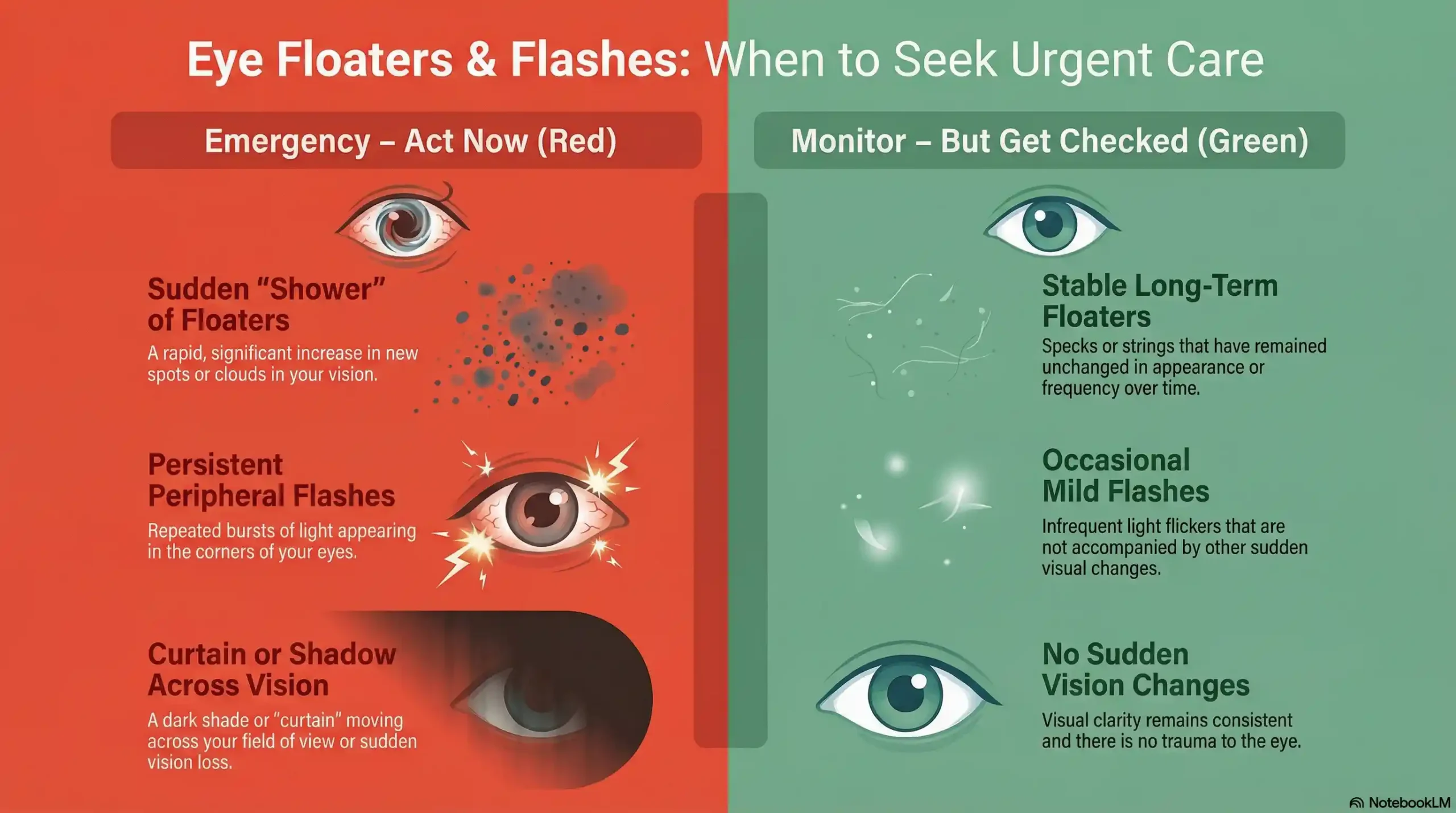
A sudden, dramatic shower of new floaters — If you go from seeing one or two familiar floaters to suddenly noticing dozens of new ones appearing at once, this is a red flag. A sudden increase in floaters can indicate that the vitreous has torn the retina, releasing pigment cells or blood into the vitreous cavity.
Flashes of light in your peripheral vision — Occasional mild flashes during a known PVD can be monitored, but persistent or newly appearing flashes — particularly in the periphery — suggest the retina may be under active traction and at risk of tearing.
A shadow, curtain, or dark veil across your vision — This is one of the most urgent warning signs of retinal detachment. If any portion of your visual field appears blocked, darkened, or covered by a shadow that does not clear, seek emergency eye care without delay.
Sudden partial or complete vision loss — Any unexplained, sudden loss of vision in one or both eyes requires immediate evaluation, whether from an eye care provider or, if one is unavailable, a hospital emergency department.
Recent eye trauma — A blow to the eye or head can cause retinal damage that may not be immediately apparent. If you have experienced any eye trauma and begin noticing floaters or flashes in the days following, have your retina examined promptly.
Symptoms That Can Be Monitored — But Still Need Evaluation
Not every floater signals an emergency. A small number of stable floaters that have been present for months or years without any change in character or frequency are typically benign. Occasional, brief flashes without any accompanying increase in floaters or changes in vision may also represent a settled PVD. However, “lower risk” does not mean “no risk.” Any new visual symptom you have not experienced before deserves professional attention.
| Symptom | Risk Level | Recommended Action |
|---|---|---|
| Sudden shower of new floaters | 🔴 HIGH | Call the eye doctor immediately |
| Persistent peripheral flashes | 🔴 HIGH | Same-day emergency evaluation |
| Shadow or curtain across vision | 🔴 CRITICAL | Immediate emergency eye care |
| Sudden partial vision loss | 🔴 CRITICAL | ER or emergency eye doctor now |
| Post-trauma floaters | 🔴 HIGH | Same-day evaluation |
| Stable floaters (months/years) | 🟢 LOW | Schedule a routine exam |
| Occasional mild flashes, no other symptoms | 🟡 MODERATE | Schedule a prompt evaluation within days |
| Floaters with known PVD diagnosis | 🟢 LOW-MODERATE | Monitor + annual exam |
Should You Go to the ER or See an Eye Doctor for Floaters in Fort Collins?
This is one of the most common questions patients ask, and it deserves a direct, practical answer.
A hospital emergency room is equipped to handle a wide range of medical crises, but retinal evaluation is highly specialized. Most ER physicians are not trained in detailed retinal examination and do not have access to the advanced imaging equipment needed to diagnose a retinal tear or early-stage detachment. In many cases, patients who visit the ER with floater symptoms are advised to follow up with an eye specialist — which means a second appointment, more time lost, and a delay in diagnosis.
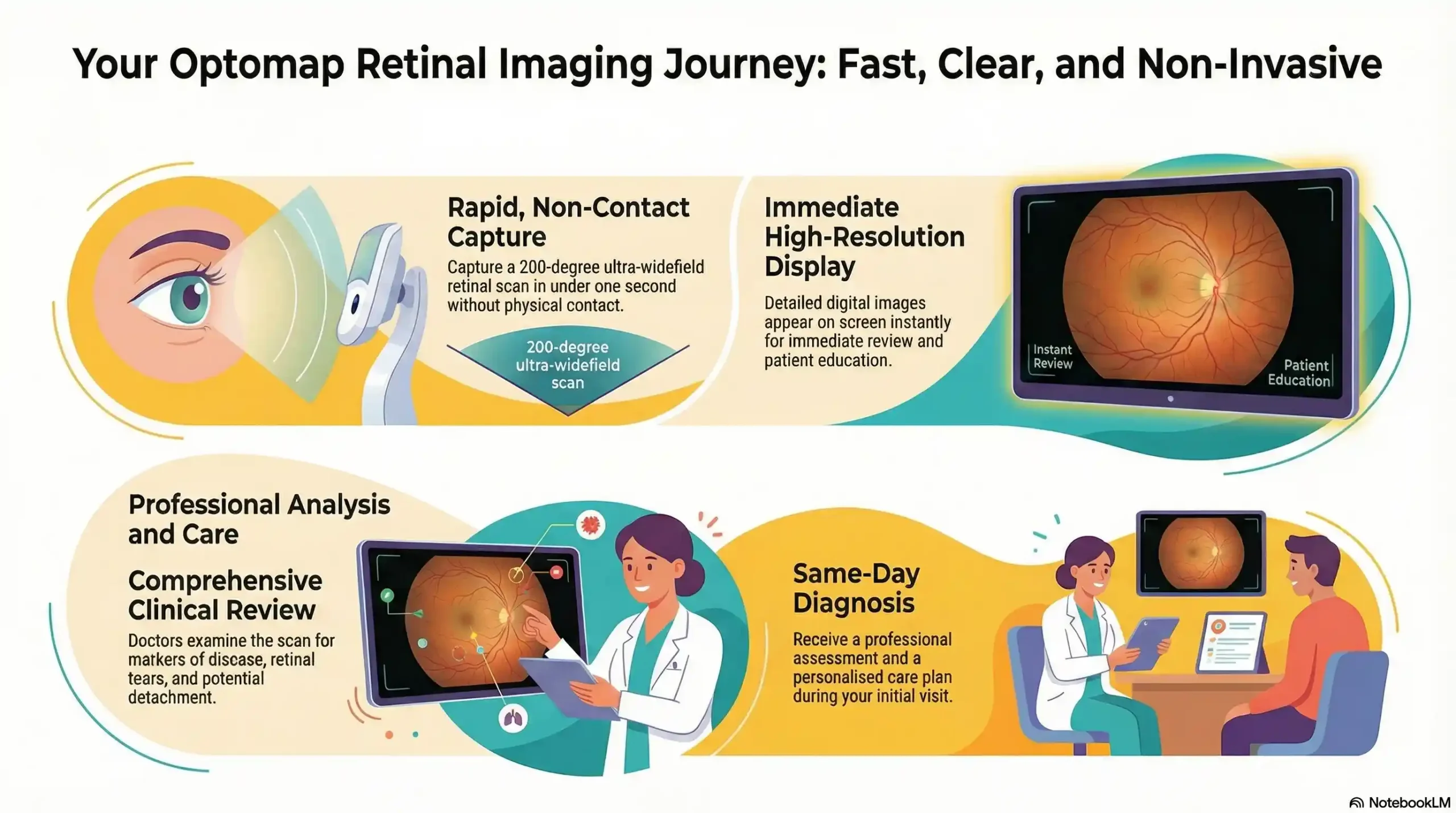
For the majority of floater and flash emergencies, your fastest and most effective path to an accurate diagnosis is a Fort Collins eye doctor equipped with retinal imaging technology. Poudre Valley Eyecare’s Optomap ultra-widefield retinal imaging system allows our team to examine up to 82% of the retinal surface in a single, non-invasive scan — providing immediate, high-resolution detail that supports accurate, same-day triage decisions.
The exception is a situation where you are experiencing complete sudden vision loss, severe eye pain, or a known injury requiring emergency medical care — in those cases, proceed directly to an emergency room or call 911.
How Poudre Valley Eyecare Diagnoses Flashes and Floaters in Fort Collins
When you come to Poudre Valley Eyecare with concerns about flashes or floaters, you are not simply getting a standard checkup. You are receiving a clinically rigorous evaluation designed specifically to identify whether your symptoms represent a benign process or a sight-threatening emergency.
Optomap Ultra-Widefield Retinal Imaging — See What Others Miss
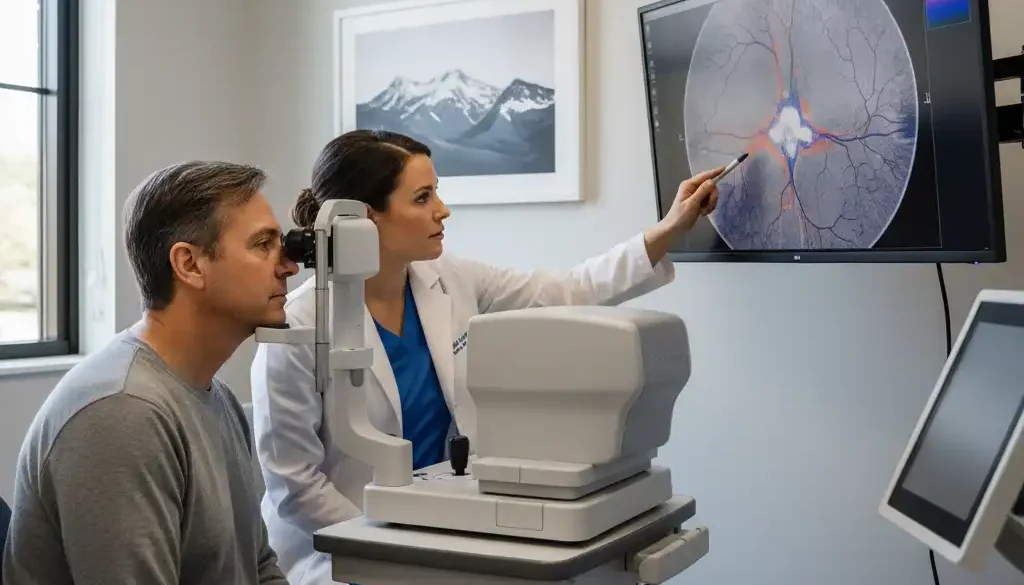
At the heart of our diagnostic process is the Optos Optomap, one of the most advanced retinal imaging systems available in optometric practice today. Unlike a traditional retinal examination, which provides a relatively limited view of the retina, the Optomap captures an ultra-widefield image that encompasses up to 200 degrees of the retinal surface in a single, rapid scan.
This matters enormously for floater and flash evaluation. Retinal tears frequently occur in the far peripheral retina — the very area that is most difficult to visualize with conventional equipment. The Optomap’s expansive field of view ensures that peripheral tears, areas of retinal thinning, and early signs of detachment are not missed. The resulting high-resolution digital image can be reviewed immediately, retained in your patient record for future comparison, and — when necessary — shared with a retinal specialist for co-management.
Beyond retinal emergencies, the Optomap’s ultra-widefield view has also demonstrated the ability to assist in identifying systemic health risks, including certain cancers and indicators of cardiovascular conditions such as stroke. It is, in every sense, a tool that looks after your whole health — not just your eyes.
What to Expect During Your Emergency Eye Exam at PVE
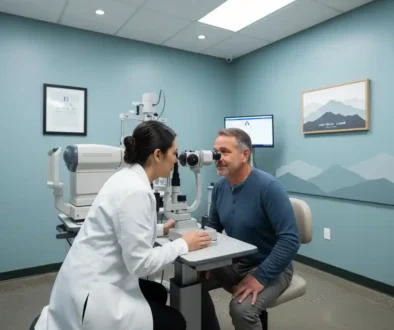
When you arrive at Poudre Valley Eyecare at 1820 S College Ave B, Fort Collins, CO 80525, our team will take your concerns seriously from the moment you walk through the door. Your emergency eye exam will include a thorough review of your symptoms and medical history, Optomap retinal imaging, a dilated eye examination to allow a direct, magnified view of the retina and vitreous, and a clear, honest conversation with your doctor about what the examination reveals and what your next steps should be.
Our commitment is not to rush you through an appointment, but to ensure you leave with complete clarity about your eye health — and a customized plan tailored specifically to your situation.
| Optomap Feature | Clinical Benefit for Floater/Flash Patients |
|---|---|
| 200-degree ultra-widefield view | Detects peripheral retinal tears often missed by conventional exam |
| Non-invasive single scan | Fast, comfortable — no eye contact required |
| High-resolution digital image | Immediate on-screen review for same-day diagnosis |
| Permanent digital record | Future comparison to track any retinal changes over time |
| Systemic disease detection | Identifies broader health risks beyond eye conditions |
Why Fort Collins Families Trust Poudre Valley Eyecare for Urgent Eye Care
Choosing an eye doctor for an emergency is not the same as choosing one for a routine exam. When your vision may be at stake, you need a practice with the experience, technology, and genuine commitment to patient care that ensures you receive the right answer — not just a fast one.
Poudre Valley Eyecare has been serving the Fort Collins community since 1991. As a family-run practice, we have built our reputation not on volume or retail sales, but on the trust of the patients and families who have relied on us across decades and across generations. Our motto — Our Focus is You — is not a marketing phrase. It is the operating principle behind every appointment, every diagnosis, and every conversation we have with our patients.
We proudly serve patients across Northern Colorado, including Fort Collins, Loveland, Wellington, Timnath, and Greeley. We accept most major insurance plans, including both Medicare and Medicaid, ensuring that cost and coverage concerns do not stand between you and the urgent care your eyes may need. Our professional affiliations with the American Optometric Association, the Colorado Optometric Association, and the Northern Colorado Optometric Association reflect a commitment to ongoing education, clinical excellence, and the highest standards of patient care.
We are not a retail chain. We are your neighbors — and we take that responsibility seriously.
Your Trusted Fort Collins Eye Care Team — Here When You Need Us
Poudre Valley Eyecare has been Fort Collins’ trusted eye care partner since 1991. 📞 (970) 493-6360 📍 1820 S College Ave B, Fort Collins, CO 80525
Local Resources & Citations
Authoritative references to support your eye health decisions in Fort Collins, CO.
1. Colorado Division of Professions and Occupations — Optometry Licensing
Verify that your Fort Collins optometrist holds a current, valid state license before your appointment — this is the official Colorado government database for licensed optometry professionals.
2. Colorado State University — Health and Medical Center, Fort Collins
CSU’s on-campus health center serves the Fort Collins community and provides referrals to local specialist eye care providers, making it a trusted starting point for students and residents seeking urgent vision guidance.
3. National Eye Institute (NEI) — Facts About Floaters
The NEI is the U.S. government’s primary eye health research authority — this page provides clinically verified, federally published information on floater causes, risk factors, and when to seek emergency care.
4. Optos — Optomap Technology Official Specifications
The official manufacturer’s page for the Optomap ultra-widefield retinal imaging system used at Poudre Valley Eyecare — consult here for verified technical specifications and clinical evidence supporting the device’s diagnostic capabilities.
Protecting Your Vision — What Happens After Your Eye Exam
A diagnosis is the beginning of care, not the end of it. Once your evaluation is complete, Poudre Valley Eyecare will work with you to determine the most appropriate path forward based on your specific findings.
If your examination reveals no retinal tear or detachment, your doctor will advise you on a monitoring protocol — including what new symptoms to watch for and when to return for a follow-up exam. Most patients experience significant peace of mind once they have received a clear diagnosis and understand what their floaters mean for their long-term eye health.
If a retinal tear is identified, prompt laser treatment — typically performed by a retinal specialist — can seal the tear and prevent progression to full detachment. Poudre Valley Eyecare co-manages surgical and specialist cases, coordinating your referral and maintaining continuity of care throughout the process. If a retinal detachment is confirmed, you will be referred for urgent surgical intervention, with our team supporting your care at every stage.
Regardless of your diagnosis, we will recommend a schedule for preventive follow-up care. Annual comprehensive eye exams remain one of the most powerful tools available for early detection of eye disease and systemic health conditions — including glaucoma, macular degeneration, diabetic retinopathy, and more. Consistent care with a trusted Fort Collins optometrist is the foundation of long-term vision health.
Frequently Asked Questions
-
Eye floaters typically appear as small, semi-transparent shapes drifting across your field of vision. They can take the form of dots, specks, threads, squiggly lines, cobweb-like strands, or ring-shaped shadows. They tend to move when your eye moves and drift slightly when you try to look at them directly, appearing to float just out of reach. Floaters are most visible when you are looking at a plain, bright background such as a clear sky or a white wall. While one or two stable floaters are generally benign, a sudden appearance of many new floaters — particularly shapes that look like a shower of dots or a dark cloud — should be evaluated by an eye doctor the same day.
Schedule your eye exam with Poudre Valley Eyecare today — Fort Collins’ most trusted family eye care practice since 1991. 📞 (970) 493-6360 📍 1820 S College Ave B, Fort Collins, CO 80525 Our Focus is You.
Please note: None of the above should be considered medical advice. If you’re having any concerns about your vision, please reach out to us immediately or see your primary care provider.