Colorado Sun vs. Your Eyes: Fort Collins Sunglasses Guide
Picture this: You’re driving west on Harmony Road during your evening commute, and suddenly the setting sun creates blinding glare that makes it impossible to see clearly through your regular glasses. You’re squinting, your eyes are watering, and you realize you’re making a dangerous choice between clear vision and eye protection. If this scenario sounds familiar, you’re experiencing one of the most common vision challenges faced by Fort Collins residents—and you’re not alone.
At our elevation of 5,003 feet, combined with Colorado’s intense sunshine and reflective surfaces, your eyes face unique challenges that require more than basic sunglasses can provide. Here’s everything you need to know about whether prescription sunglasses are right for your Fort Collins lifestyle.
Why Fort Collins Creates Unique Eye Protection Challenges
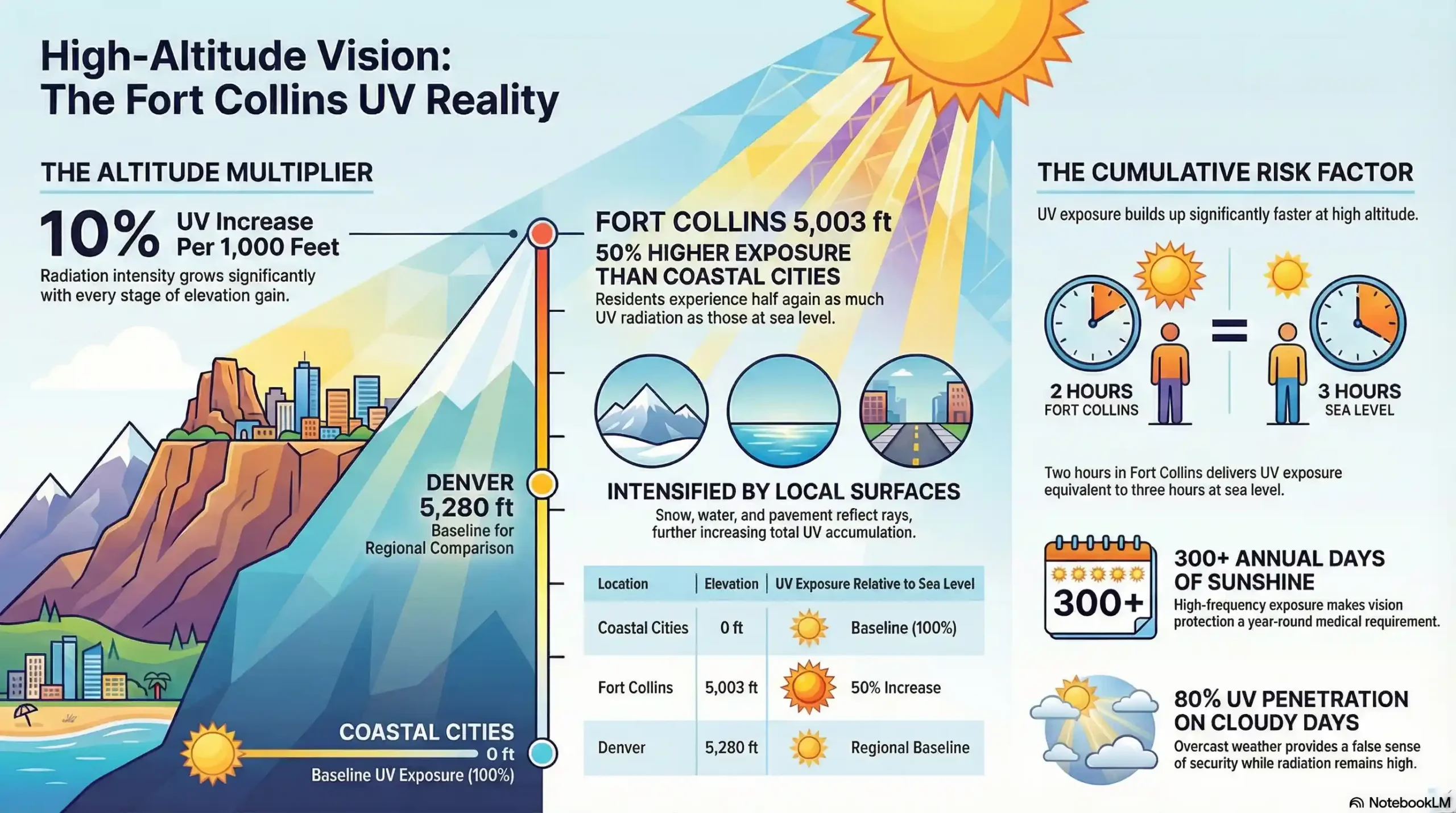
At Fort Collins’ 5,003-foot elevation, your eyes receive approximately 25% more harmful UV radiation than at sea level. This isn’t marketing hyperbole—it’s basic atmospheric physics. For every 1,000 feet of elevation gain, UV exposure increases by 10-12%.
Colorado’s 300+ annual days of sunshine compound this exposure. Fort Collins regularly sees UV index readings between 8 and 11 during peak months, compared to the national average of 6-8. This means every hour you spend outdoors without proper eye protection—whether you’re walking around Old Town, hiking at Horsetooth Reservoir, or simply driving to work—contributes to irreversible damage that accumulates over decades.
The challenge becomes more complex when you consider Fort Collins’ specific conditions:
Morning glare off Horsetooth Reservoir can create temporary vision impairment while driving on Highway 14 or Taft Hill Road. Winter conditions create double exposure—direct sunlight plus reflection off snow can nearly double UV intensity. Even overcast days allow up to 80% of UV rays to penetrate clouds, meaning protection is necessary year-round.
For residents over 40, these risks intensify. Age-related changes in the eye’s natural defenses make UV damage more likely, while Colorado’s dry climate (averaging just 14% humidity) exacerbates existing dry eye conditions that make eyes more vulnerable to environmental damage.
The medical reality: UV damage to your eyes is completely preventable, but only if you take action before the damage occurs. Unlike sunburned skin, your eyes don’t immediately show signs of overexposure. The damage accumulates silently, often not becoming apparent until your 50s or 60s when cataracts develop, or macular degeneration begins affecting central vision.
Fort Collins Seasonal Usage Guide
- Spring (March-May): Essential for allergy season – reduced squinting helps minimize eye irritation
- Summer (June-August): Peak usage period – UV index regularly exceeds 10
- Fall (September-November): Critical for morning/evening commutes as sun angles lower
- Winter (December-February): Necessary for snow glare – reflection can double UV exposure
Why Standard Solutions Fail Fort Collins Residents
If you wear prescription glasses, every current solution forces you to choose between seeing clearly and protecting your eyes—a compromise that becomes dangerous on Colorado’s mountain roads.
The Clip-On Problem
Clip-on sunglasses present multiple safety and practical issues. They scratch your prescription lenses over time, reducing the clarity you’ve paid for. More critically, they can be dangerous to put on or remove while driving—a significant concern when navigating bright morning glare on Highway 14 or sudden shadow-to-sunlight transitions in the foothills.
The added weight causes frames to slip, constantly requiring adjustment. During outdoor activities like hiking or cycling, this becomes more than an annoyance—it becomes a safety issue when you need both hands free and stable vision.
The Photochromic Limitation
Photochromic lenses (transition lenses) fail precisely when Fort Collins drivers need them most. Car windshields block the UV rays that trigger the darkening response, leaving you with clear lenses while driving in bright conditions. This is particularly problematic for Fort Collins commuters who spend significant time in vehicles, especially during morning and evening drives when sun angles create maximum glare.
The Contact Lens Compromise
With Fort Collins’ humidity levels averaging just 14%, contacts become uncomfortable quickly during outdoor activities. Wind and dust during hiking, cycling, or yard work often lead to dry, irritated contacts that you want to remove, leaving you without vision correction when you need it most.
Even if contacts stay comfortable, switching between regular glasses and non-prescription sunglasses throughout the day creates inconvenience that often results in skipped protection altogether. For people over 40 who need reading glasses, this juggling act becomes even more complicated.
Is This Investment Right for Your Fort Collins Lifestyle?
Prescription sunglasses typically cost $300-500, making them worthwhile if you spend more than six hours weekly outdoors or drive regularly in bright conditions. The key is honestly assessing your lifestyle patterns and understanding when the investment makes financial and practical sense.
Usage-Based Assessment
Consider this calculation: At $400 for a quality pair lasting three years, you’re paying about $133 annually. If you use them three times per week for activities like hiking, driving to Denver, or outdoor work, that breaks down to roughly $0.85 per use—less than most people spend on coffee.
You’ll likely benefit if you:
- Drive more than 30 minutes daily, especially during morning or evening commutes
- Work outdoors or in environments with significant window exposure
- Participate in weekend hiking, cycling, or water activities
- Spend time at Horsetooth Reservoir, Boyd Lake, or other reflective environments
- Experience frequent squinting or eye strain in bright conditions
Consider alternatives if you:
- Work primarily indoors with minimal driving
- Spend fewer than three hours weekly in bright outdoor conditions
- Have budget constraints that should prioritize updating daily prescription glasses first
- Expect prescription changes in the next year due to age-related vision changes
Fort Collins Seasonal Considerations
Colorado’s seasonal patterns should influence your decision. While summer use is obvious, consider whether you’ll use prescription sunglasses during Fort Collins’ bright winter months when snow reflection can be intense. If you ski, snowshoe, or simply spend time outdoors year-round, the investment becomes more justifiable.
Prescription stability matters. If you expect prescription changes due to existing eye conditions or are considering LASIK, timing your sunglasses purchase becomes important. Most adults’ prescriptions stabilize, and minor changes often don’t require immediate replacement unless they affect comfort or clarity.
Not sure if prescription sunglasses are right for your Fort Collins activities? We offer complimentary vision protection assessments to help you understand your options without any pressure to purchase.
Prescription Sunglasses Technology: What Actually Matters in Colorado
For Fort Collins conditions, impact-resistant lenses and 100% UV protection are essential, while polarization provides significant benefits for activities involving water, snow, or driving—though it can interfere with some digital displays.
Essential Features for Every Fort Collins Resident
- Impact resistance is non-negotiable if you participate in any outdoor activities. Polycarbonate and Trivex lenses resist shattering from flying debris during hiking, cycling, or yard work—common scenarios around Fort Collins. These materials are also significantly lighter than glass, reducing nose bridge pressure during extended wear.
- Anti-reflective coating becomes crucial for driving safety. It eliminates reflections from the back surface of your lenses that can create distracting visual interference, particularly important during morning and evening commutes when sun angles are low.
- 100% UV protection might seem obvious, but it’s the foundation of eye safety. Look for lenses that block both UVA and UVB rays. Quality matters more than price—even basic prescription sunglasses from reputable sources provide adequate UV protection.
High-Value Add-Ons for Active Lifestyles
- Polarization dramatically reduces glare from reflective surfaces—water, snow, wet pavement, and car hoods. For activities at Horsetooth Reservoir, skiing, or even driving on I-25 during peak sun hours, polarized lenses can transform your visual comfort. However, they can make LCD screens (phones, car dashboards, and some outdoor equipment displays) difficult to read, requiring you to tilt your head to see them clearly.
- Wrap-around frame styles provide peripheral protection from wind and UV rays—particularly valuable for cycling, hiking, or motorcycling. They also reduce dry eye symptoms by creating a more humid microenvironment around your eyes, important in Colorado’s dry climate.
- Scratch resistance becomes essential in Colorado’s dusty, windy environment. Quality anti-scratch coatings extend lens life and maintain optical clarity.
Activity-Specific Recommendations
- Hiking and camping: Prioritize impact resistance and wrap coverage. Brown or amber tints enhance contrast on trails, making it easier to spot rocks, roots, and terrain changes.
- Driving: Polarization and anti-reflective coatings provide maximum safety benefits. Gradient tints (darker at top, lighter at bottom) help with glare while maintaining the ability to read dashboard instruments.
- Water activities: Polarization becomes nearly essential, eliminating the blinding glare that can be dangerous around boats or while fishing at Horsetooth or Boyd Lake.
- Snow sports: Require high-quality UV protection due to intense reflection, but polarization can sometimes interfere with reading snow conditions and shadows. Discussing this trade-off with an experienced eye care provider helps determine the best option for your specific activities.
Features That May Not Justify Extra Cost
Photochromic technology in prescription sunglasses is redundant—you’re already getting dedicated sun protection. Designer frame upgrades provide style but don’t improve protection or comfort significantly. Multiple lens tints sound appealing, but most people stick with one versatile option that works for their primary activities.
What to Expect: Your First Month with Prescription Sunglasses
Expect 3-5 days to fully adjust to prescription sunglasses, with possible mild eye fatigue and depth perception changes during the first week—this is normal and temporary. Understanding what’s normal versus what requires attention helps ensure a successful transition.

Days 1-3: Initial Adjustment Period
Colors will appear more vivid and saturated than you’re used to, which can initially feel overwhelming but becomes comfortable quickly. This enhanced color perception is actually beneficial—it’s your eyes receiving better protection while maintaining full color information.
Depth perception may feel slightly different, particularly when walking down stairs or stepping off curbs. This is your brain adapting to the new visual input and resolves naturally as your visual system recalibrates.
Mild eye fatigue during the first few days is normal as your visual system adjusts to the tinted environment. This is particularly common if you’re switching between prescription sunglasses and regular glasses frequently. The fatigue should decrease each day.
Week 1: Building New Habits
Your brain will start automatically adjusting to the tinted environment, and the enhanced comfort in bright conditions becomes apparent. You’ll begin developing wearing patterns—remembering to put them on before going outside and finding convenient storage spots in your car, home, and office.
Some people notice they’re more sensitive to bright lights when not wearing their prescription sunglasses during this period. This is temporary and actually indicates your eyes are becoming accustomed to proper protection.
Weeks 2-4: Full Integration
By the second week, prescription sunglasses should feel completely natural. You’ll notice improved comfort during activities that previously caused eye strain—driving, outdoor work, or recreational activities. The enhanced contrast and reduced glare become benefits you actively appreciate rather than just the absence of discomfort.
When to Seek Professional Guidance
Contact your eye care provider immediately if you experience:
- Persistent headaches after the first week
- Any double vision or visual distortion
- Continued discomfort that doesn’t improve daily
- Vision that seems worse than with regular glasses
Normal adaptation includes:
- Mild fatigue for 3-5 days
- Temporary color adjustment
- Slight depth perception changes initially
Optimizing your experience: Keep prescription sunglasses in consistent locations (car console, office desk, by front door) to develop automatic wearing habits. Clean lenses daily in Colorado’s dusty environment to maintain optimal clarity.
Ready to protect your vision with prescription sunglasses designed for Colorado conditions? Schedule your comprehensive eye exam and lens consultation to get started.
The Real Costs: Investment Planning and Insurance Coverage
Prescription sunglasses in Fort Collins typically cost $250-600, depending on lens technology and frame selection, with most vision insurance plans covering $100-150 of this cost, though coverage varies significantly between plans.
Typical Fort Collins Pricing
- Basic prescription sunglasses with UV protection and impact-resistant lenses typically run $250-350. This includes standard frames and single-vision lenses with essential coatings—adequate protection for most Fort Collins residents.
- Mid-range options ($350-450) add polarization, better frame materials, and enhanced scratch resistance. Progressive lens prescriptions typically add $100-150 to any package.
- Premium selections ($450-600+) include designer frames, advanced lens technologies, or multiple specialized coatings. These features provide convenience and style benefits but don’t necessarily offer better protection than mid-range options.
Understanding Insurance Coverage
Most vision plans provide a sunglasses allowance separate from your regular eyewear benefit, typically $100-150 annually. Some plans treat prescription sunglasses as a second pair, which may reduce your total allowance.
Medical insurance occasionally covers prescription sunglasses if deemed medically necessary—for example, if you have certain eye conditions that make UV protection critical. However, this requires documentation and medical evaluation to determine necessity.
HSA and FSA accounts typically cover prescription sunglasses since they’re medically necessary devices, making them an excellent use of pre-tax dollars.
Long-Term Value Analysis
Quality prescription sunglasses last 3-4 years with proper care, making the annual cost $75-150. Compare this to alternatives:
- Clip-ons: $40-80, need replacement every 1-2 years, plus inconvenience and safety concerns
- Contact lens wearers: $200-300 annually on contacts plus $50-100 on sunglasses
When prescription changes affect cost: If your prescription changes significantly, you’ll need new lenses, typically costing 60-70% of the original price. However, minor changes often don’t require immediate replacement unless they affect comfort or clarity.
Budgeting Strategies
If cost is a concern, prioritize updating your daily prescription glasses first—you’ll use these far more often. Consider starting with basic prescription sunglasses and upgrading later, or timing purchases around insurance benefit periods.
Many Fort Collins practices offer payment plans for prescription eyewear, allowing patients to spread the cost over several months. Some offer package deals when purchasing multiple pairs at once.
Have questions about insurance coverage or want to discuss your specific vision needs? Our Fort Collins team can answer your questions over the phone and help you understand your options.
Local Resources for Fort Collins Residents
City of Fort Collins Parks, Recreation & Community Service
Find information on Fort Collins outdoor recreation areas (Poudre Trail access points, Horsetooth Reservoir facilities, local parks) where UV exposure is highest during peak hours—helping you identify when and where eye protection matters most for your activities.
CSU Atmospheric Science Department – UV Research
Access peer-reviewed research on how Colorado’s elevation affects UV radiation intensity and health impacts—providing scientific context for why Fort Collins residents face higher UV exposure than national averages.
NWS Boulder – UV Index and Weather Data
Check daily UV Index forecasts for Fort Collins to understand when UV levels are extreme (8-10+) and require maximum eye protection—particularly important during summer months and high-altitude outdoor activities.
Larimer County Health Department – Sun Safety Information
Find local public health guidance on UV protection specific to Northern Colorado’s climate and elevation—including educational resources on preventing UV-related health conditions in high-altitude environments.
Your Next Steps: Protecting Your Vision in Fort Collins
If you drive regularly in Colorado conditions or spend more than six hours weekly outdoors, prescription sunglasses will likely improve both your immediate comfort and long-term eye health. The next step is a comprehensive eye examination to assess your current vision needs and determine whether prescription sunglasses fit your lifestyle and budget.
Ready for Prescription Sunglasses?
You’re likely a good candidate if you:
- Squint frequently while driving or during outdoor activities
- Avoid certain activities due to bright light discomfort
- Currently juggling between regular glasses and clip-ons or contacts with sunglasses
- Spend significant time at Horsetooth Reservoir, hiking trails, or other bright outdoor environments
- Work outside or drive professionally in the Fort Collins area
- Experience eye strain during Colorado’s intense morning or evening sun
Consider Waiting If:
- You expect prescription changes in the next 6-12 months
- Your budget requires prioritizing daily prescription glasses first
- You work primarily indoors and drive less than 30 minutes daily
- You’re planning vision correction surgery
The Professional Assessment Process
Rather than pushing expensive upgrades, a proper evaluation focuses on determining whether prescription sunglasses actually make sense for your specific situation. After understanding your lifestyle, work requirements, and recreational activities, an experienced practitioner will evaluate your current eye health, assess UV damage risk factors, and discuss options that fit your budget.
A thorough consultation includes:
- Examination of current prescription accuracy and eye health
- Discussion of typical daily activities and UV exposure patterns
- Explanation of protection options without sales pressure
- Honest recommendations based on individual needs
Taking Action
Your vision health in Fort Collins requires protection that matches our unique environment. Professional vision assessment helps determine the best approach for your individual needs, whether that’s prescription sunglasses, alternative protection methods, or timing recommendations for future purchases.
Understanding your options through a comprehensive eye care consultation ensures you make an informed decision that balances protection, practicality, and budget considerations. The goal is finding the right solution for your Fort Collins lifestyle—not the most expensive one.
Service Areas: Poudre Valley Eyecare serves Fort Collins, Windsor, Timnath, Wellington, and surrounding Larimer County communities with comprehensive eye care and prescription eyewear services.
FAQs
-
Yes, if you spend regular time outdoors in Fort Collins. At 5,003 feet elevation, you’re exposed to 25% more UV radiation than at sea level, which accelerates cumulative eye damage leading to cataracts and macular degeneration.
Please note: None of the above should be considered medical advice. If you’re having any concerns about your vision, please reach out to us immediately or see your primary care provider.