Reading Glasses at 45: What’s Happening to Your Eyes
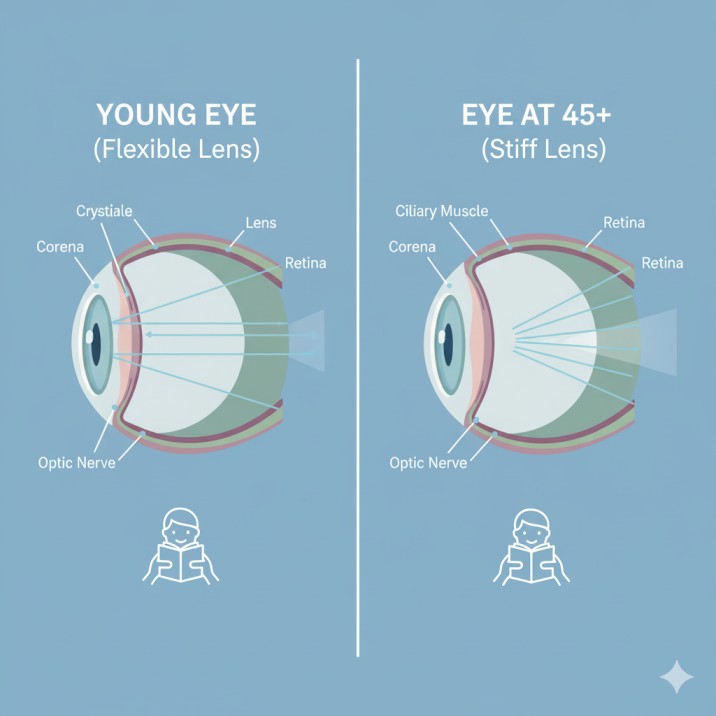
If you’re around age 45 and suddenly find yourself holding your phone at arm’s length to see clearly, you are likely experiencing presbyopia. This natural, universal stiffening of the eye’s lens affects nearly 90% of American adults by their mid-40s, making near-focus tasks like reading increasingly difficult. While the change feels sudden, it is a highly manageable stage of the aging process that can be addressed with specialized lenses, treatments, or simple lifestyle adjustments
Understanding Presbyopia: The Universal Eye Condition
What Makes Presbyopia Different
Unlike nearsightedness, farsightedness, and astigmatism, presbyopia does not discriminate. At some point, we will all succumb to its effects and need to do something to maintain clarity with our near vision. This universality means that even if you’ve enjoyed perfect vision your entire life, presbyopia will eventually affect you.
The Global Impact
As of 2025, presbyopia affects approximately 1.8 billion people worldwide, representing about 25% of the global population. This number is projected to reach 2.1 billion by 2030 due to aging demographics. In the United States specifically, presbyopia affects 83% to 89% of adults aged 45 and older, with an estimated 128-139 million Americans currently experiencing this condition.
Recognizing Presbyopia Symptoms: Beyond Blurry Vision
Primary Symptoms to Watch For
If you’re wondering whether you need reading glasses at 45, look for these telltale signs. Many people experience a sudden need for reading glasses when these symptoms appear:
Visual Changes:
- Holding books, phones, or menus farther away to read clearly
- Blurred vision when reading at normal distances (14-16 inches)
- Difficulty seeing fine print, especially in dim lighting
- Needing more light to read comfortably
Physical Symptoms:
- Eye strain and fatigue during close-up tasks
- Headaches after reading or computer work
- Sore, tired eyes at the end of the day
- Difficulty transitioning focus from near to far objects
When Presbyopia Becomes Problematic
Trouble seeing clearly at close distances is one of the most common problems people develop between ages 41 and 60—it affects nearly 80% of North American adults ages 45 to 55.
The condition typically progresses in predictable stages:
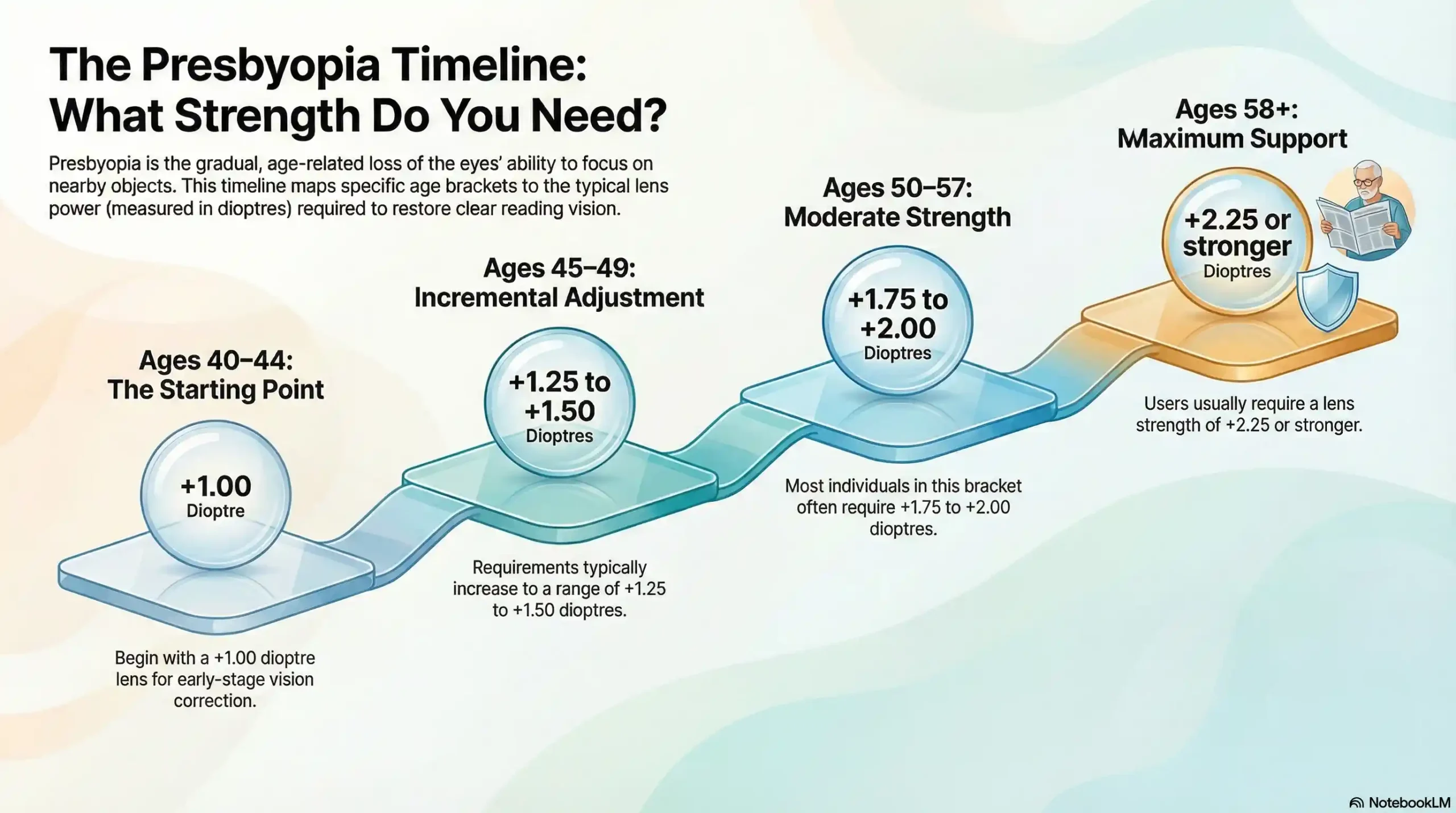
- Ages 40-44: Begin with +1.00 diopter reading glasses
- Ages 45-49: Typically need +1.25 to +1.50 diopter
- Ages 50-57: Often require +1.75 to +2.00 diopter
- Ages 58+: Usually +2.25 diopter or stronger
The Emotional Impact of Sudden Vision Changes
Coming to Terms with Aging
For many people, the sudden need for reading glasses at 45 represents their first real confrontation with aging. For those with aging eyes, the need for reading glasses may signal the onset of middle age. This can be a troubling time because your body and mindset might feel as young as they did in your 30s, but your eyes no longer keep up.
Overcoming the Psychological Barriers
It’s completely normal to feel frustrated, annoyed, or even in denial about needing reading glasses. Many patients express concerns about:
- Looking older or less attractive
- Feeling dependent on glasses for the first time
- Worrying about the progression of vision problems
- The inconvenience of constantly putting glasses on and off
Remember: These feelings are valid and shared by millions of people going through the same transition. Working with an experienced eye care professional can help address both the practical and emotional aspects of presbyopia.
Schedule Your 45+ Vision Assessment in Fort Collins
Treatment Options: Finding the Right Solution for Your Lifestyle
Reading Glasses: The Most Common Solution
For most people experiencing sudden presbyopia at 45, reading glasses provide immediate relief. Whether you have a sudden need for reading glasses or have been gradually noticing changes, you have several options:
Over-the-Counter Readers:
- Convenient and affordable
- Available in various strengths
- Good for people with no other vision problems
- Best to start with lower powers (+1.00 to +1.25)
Prescription Reading Glasses:
- Customized to your exact needs
- Account for any astigmatism or other refractive errors
- Provide optimal clarity and comfort
- Recommended for regular use
Progressive and Multifocal Options
If you already wear glasses for distance vision, your Fort Collins eye doctor might recommend:
- Bifocals: Traditional option with a visible line separating distance and near zones
- Progressive Lenses: No visible lines, gradual transition between distances
- Trifocals: Three distinct zones for distance, intermediate, and near vision
Contact Lens Solutions
- Multifocal Contact Lenses: Provide clear vision at all distances within a single lens
- Monovision: One eye corrected for distance, the other for near vision
Emerging Presbyopia Treatments
Recent advances have introduced new options for presbyopia management. The global presbyopia treatment market is experiencing significant growth, valued at $10.70 billion in 2025 and projected to reach $16.77 billion by 2033.
FDA-Approved Eye Drops: Recent FDA approval of pilocarpine-based eye drops offers a non-invasive treatment option for presbyopia correction.
Surgical Options: Modern procedures include presbyLASIK and advanced intraocular lens implants that can reduce dependence on reading glasses.
When to See an Eye Doctor in Fort Collins
The Importance of Professional Diagnosis
While over-the-counter reading glasses can provide temporary relief, it’s important to schedule an eye exam with an optometrist when you notice vision changes. They will be able to rule out any other potential causes of vision problems.
What to Expect During Your Eye Exam
At Poudre Valley Eyecare, our comprehensive presbyopia evaluation includes:
- Visual Acuity Testing: Determining your exact reading prescription needs
- Accommodation Assessment: Measuring your eye’s focusing ability
- Eye Health Examination: Ruling out other age-related conditions
- Lifestyle Consultation: Discussing the best correction options for your daily activities
Red Flag Symptoms Requiring Immediate Attention
Seek prompt eye care if you experience:
- Suddenly, severe vision changes
- Eye pain or persistent headaches
- Flashing lights or increased floaters
- Loss of peripheral vision
- Double vision
Preventing Further Vision Problems
Protecting Your Eye Health at 45+
While presbyopia itself cannot be prevented, you can take steps to maintain overall eye health:
Nutrition for Eye Health: Research suggests that omega-3 fatty acids found in cold-water fish like salmon, sardines, and mackerel may support overall eye health. The American Heart Association recommends eating fish at least twice weekly. If you don’t eat fish regularly, consult your eye doctor about whether omega-3 supplements might be appropriate for your individual needs.
Hydration: Keeping your body well hydrated helps your eyes function optimally, so drink plenty of water throughout the day.
Regular Eye Exams: Annual comprehensive eye exams become crucial after 40 to monitor for other age-related conditions like glaucoma and macular degeneration.
Digital Eye Strain Prevention
As someone who suddenly needs reading glasses at 45, you might also be dealing with increased screen time demands:
- Follow the 20-20-20 rule: Every 20 minutes, look at something 20 feet away for 20 seconds
- Adjust screen brightness and contrast appropriately
- Position screens 20-26 inches from your eyes
- Consider blue light filtering lenses
Living Successfully with Presbyopia
Workplace Accommodations
Many people first notice they need reading glasses at 45 when working at their computer or reading documents. Here are key workplace adjustments:
Computer Work:
- Adjust the monitor height so the top of the screen is at eye level
- Use larger fonts when possible
- Consider computer-specific reading glasses
- Ensure adequate lighting
Reading Tasks:
- Invest in good task lighting
- Take frequent breaks during extended reading
- Keep reading glasses in multiple locations
- Consider magnifying tools for very small print
Travel and Daily Life Tips
Organization Strategies:
- Keep backup reading glasses in your car, office, and home
- Use a glasses chain or lanyard for convenience
- Consider photochromic lenses for outdoor reading
- Invest in a good glasses case to prevent scratches
The Progression of Presbyopia: What to Expect
Timeline of Changes
Understanding how presbyopia progresses can help you plan for future needs:
- Early 40s: Initial symptoms may appear, occasional difficulty with fine print
- Mid-40s: Clear need for reading glasses becomes consistent
- Late 40s to 50s: Prescription strength increases gradually every 2-3 years
- 60s and beyond: Presbyopia typically stabilizes, fewer prescription changes needed
By your 60s, your vision will likely have re-stabilized, and you won’t need to keep adjusting your prescription as frequently.
Managing Prescription Changes
Most people need prescription updates every 2-3 years during their 40s and 50s. The decrease in reading ability will continue as you age, whether you wear reading glasses or not.
Important Note: Using reading glasses does not make your vision worse—time and the natural aging process cause presbyopia to progress.
Recent Advances in Presbyopia Research
2024-2025 Scientific Developments
The field of presbyopia treatment continues to evolve rapidly. Current research is moving beyond a lens-centric approach toward a systems-level understanding that encompasses the dynamic interplay between the eye’s biomechanical components.
Emerging Treatment Options
New pharmaceutical treatments are in development, with several medications progressing through Phase III clinical trials. These treatments aim to restore some of the eye’s natural focusing ability through innovative approaches.
The Future of Presbyopia Care
Current projections indicate that the presbyopic population will grow from approximately 1.8 billion people in 2025 to 2.1 billion by 2030. By 2050, presbyopia is expected to affect over 4 billion people globally (approximately 40% of the world’s population).
Why Choose Poudre Valley Eyecare for Your Presbyopia Care
Expert Care in Fort Collins
At Poudre Valley Eyecare, we understand that suddenly needing reading glasses at 45 can be overwhelming. Our team, led by Dr. Eric Torgerson, brings over 25 years of experience helping Fort Collins families navigate vision changes with confidence and clarity.
Our Presbyopia Services Include:
- Comprehensive eye examinations
- Personalized reading glass prescriptions
- Progressive and multifocal lens fitting
- Contact lens options for presbyopia
- Ongoing vision care management
Why Our Patients Choose Us:
- Trusted Experience: Quarter-century legacy of consistent, quality care
- Comprehensive Coverage: Medicare and Medicaid acceptance
- Local Convenience: Established Fort Collins location with easy access
- Family Focus: Complete eye care for all ages and life stages
Scheduling Your Presbyopia Consultation
Don’t let sudden vision changes disrupt your daily life. Our caring team is ready to help you find the perfect solution for your reading vision needs.
Contact Poudre Valley Eyecare:
- Phone: (970) 493-6360
- Address: 1820 S College Ave B, Fort Collins, CO 80525
- Hours: Monday-Friday 9 AM-5 PM, Saturday 9 AM-1 PM
- Website: www.poudrevalleyeyecare.com
Resources and Citations
This article draws from extensive research and authoritative sources to provide you with accurate, up-to-date information about presbyopia and reading glasses at 45. Here are three key resources used in developing this comprehensive guide:
1. BCLA CLEAR Presbyopia: Epidemiology and Impact (2024)
Source: British Contact Lens Association – Contact Lens and Anterior Eye Journal
Link: https://www.sciencedirect.com/science/article/pii/S1367048424000493
Key Insights: This comprehensive 2024 study provided crucial statistics showing that presbyopia affects 1.8 billion people globally (25% of the population), with projections reaching 2.1 billion by 2030.
2. Presbyopia Statistics Worldwide in 2025
Source: Eye Health Central – Contact Lenses Plus Education
Link: https://www.contactlensesplus.com/education/presbyopia-stats
Key Insights: This 2025 analysis confirmed that in the United States, presbyopia affects 83-89% of adults aged 45 and older, representing approximately 128-139 million Americans.
3. AAO 2025: The Rise of Presbyopia Research
Source: Ophthalmology Times – Clinical Insights
Link: https://www.ophthalmologytimes.com/view/aao-2025-the-rise-of-presbyopia-research
Key Insights: The latest 2025 American Academy of Ophthalmology research highlighted advances in presbyopia treatment technology and patient care approaches.
Conclusion: Embracing Clear Vision at Every Age
Suddenly needing reading glasses at 45 marks the beginning of a new chapter in your vision journey, not an ending. Presbyopia affects virtually everyone, and with today’s advanced treatment options, maintaining clear, comfortable vision is entirely achievable.
Key Takeaways:
- Presbyopia is a natural, universal aging process that typically begins in the mid-40s
- Multiple treatment options exist, from simple reading glasses to advanced surgical procedures.
- Professional eye care is essential for proper diagnosis and optimal vision correction.
- The condition is manageable and shouldn’t limit your daily activities or quality of life.
The most important step is seeking a professional evaluation. An experienced eye care provider can help determine the best approach for your specific needs, lifestyle, and vision goals.
Remember, millions of people successfully manage presbyopia while maintaining active, fulfilling lives. With the right care and correction, your sudden need for reading glasses at 45 becomes simply another step toward lifelong clear vision.
FAQs
-
You’re experiencing presbyopia, a natural age-related condition where your eye’s lens loses flexibility and can’t focus on close objects. This affects everyone between ages 40-50, regardless of previous vision health.
Please note: None of the above should be considered medical advice. If you’re having any concerns about your vision, please reach out to us immediately or see your primary care provider.