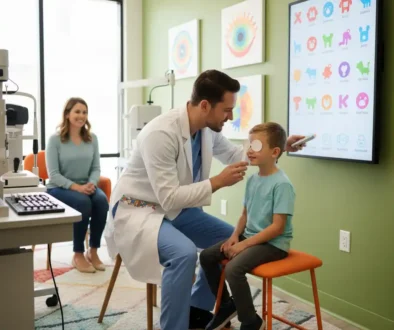
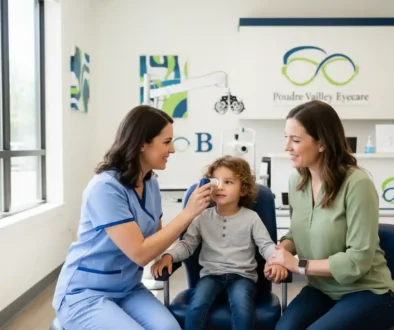
Pediatric Eye Doctor Fort Collins | Signs of Vision Problems
Common signs that a child may have a vision problem include squinting, sitting too close to screens, frequent headaches, rubbing their eyes, losing their place while reading, and avoiding close-up tasks. Because children rarely recognize or report blurry vision, parents must watch for behavioral and physical cues. If you notice these signs, a comprehensive pediatric eye exam — not just a school screening — is the recommended next step.
Vision is the foundation of how your child experiences the world — how they learn, play, explore, and grow. Yet one of the most important truths every Fort Collins parent should know is this: most children with vision problems never complain about them.
Not because they are hiding something. But because they have never known anything different.
To a child who has always seen the world as blurry, fuzzy, or doubled, that experience simply feels normal. They have no frame of reference for what clear vision looks like. This silent gap between a child’s vision reality and a parent’s awareness is where problems take root — and where early detection becomes one of the most powerful gifts a parent can give.
At Poudre Valley Eyecare, serving Fort Collins families since 1991, we understand that navigating your child’s eye health can feel overwhelming. This guide is designed to give you the clear, honest information you need — so you know exactly what to watch for, when to act, and what to expect when you do.
Why Children Rarely Complain About Vision Problems
The “I Thought Everyone Saw Like This” Problem
Imagine growing up never knowing that the leaves on trees had individual edges, or that the whiteboard at school was supposed to be sharp and clear from the back of the classroom. For children with undetected vision problems, this is simply their normal.
Unlike adults who develop vision problems later in life and can immediately recognize the change, children have no baseline for comparison. A child with moderate nearsightedness does not experience their world as “blurry” — they experience it as the only world they have ever known. This is why children almost never self-report vision difficulties, and why the responsibility of early detection rests squarely — and understandably — on the shoulders of parents and educators.
Behavioral cues, not verbal complaints, are the primary language of pediatric vision problems. Learning to read those cues is essential.
Why School Vision Screenings Are Not Enough
Many parents feel reassured when their child passes a school vision screening. It is important to understand, however, that school screenings and comprehensive eye exams are fundamentally different tools with very different capabilities.
A school vision screening is a basic pass/fail test, typically checking only distance visual acuity using a letter chart. It is valuable as a first filter, but it is not designed to detect the full range of conditions that affect children’s vision and development.
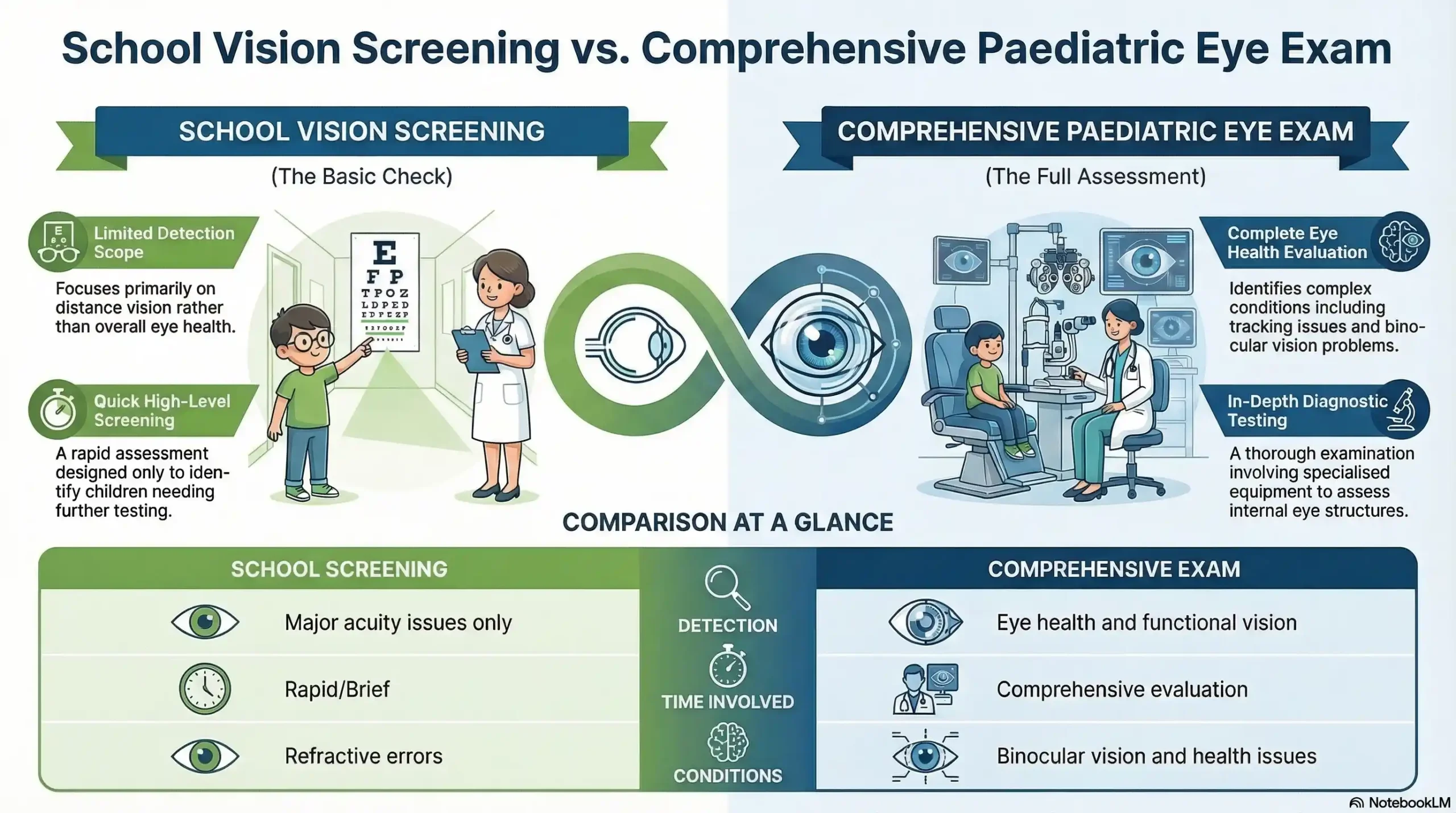
| Factor | School Vision Screening | Comprehensive Eye Exam |
|---|---|---|
| Distance Vision | ✅ Checked | ✅ Checked |
| Near Vision | ❌ Often Not Tested | ✅ Checked |
| Eye Coordination | ❌ Not Tested | ✅ Checked |
| Amblyopia (Lazy Eye) | ❌ Frequently Missed | ✅ Detected |
| Strabismus (Crossed Eyes) | ⚠️ Partially | ✅ Fully Evaluated |
| Color Vision | ❌ Not Tested | ✅ Checked |
| Eye Health & Disease | ❌ Not Evaluated | ✅ Fully Examined |
| Prescription Accuracy | ❌ Not Provided | ✅ Full Refraction |
| Administered By | School Nurse / Volunteer | Licensed Optometrist |
| Time Required | 2–5 Minutes | 45–60 Minutes |
A child can pass a school vision screening and still have a clinically significant vision condition that is affecting their learning and quality of life. A comprehensive eye exam is the only way to know for certain.
10 Warning Signs Your Child May Have a Vision Problem
Because children do not self-report vision difficulties, parents need to become active observers. The following signs are the behavioral, academic, and physical signals that vision care professionals most commonly associate with undetected pediatric vision problems.
Behavioral Signs at Home
1. Squinting or partially closing one eye. Squinting temporarily changes the shape of the eye and can improve focus. If your child squints consistently — especially when watching television or looking at objects at a distance — this is a strong signal that their eyes are working harder than they should be.
2. Sitting unusually close to screens or books. Moving physically closer to a screen or page is an unconscious compensation for poor distance or near vision. If your child consistently positions themselves very close to the television, tablet, or their reading material, take note.
3. Tilting their head or covering one eye. These are compensatory behaviors that suggest the two eyes may not be working together properly. A child who tilts their head when focusing, or who habitually covers one eye, may be experiencing double vision or an eye alignment issue.
4. Excessive eye rubbing — outside of tiredness. While all children rub their eyes when sleepy, persistent rubbing throughout the day can indicate eye strain, fatigue, or an underlying vision condition.
5. Avoiding activities that require close work. A child who resists reading, puzzles, drawing, or coloring may be avoiding these activities because they cause visual discomfort — not because they lack interest.
Academic & Classroom Red Flags
6. Losing their place while reading or using a finger to track. This is one of the most frequently overlooked classroom signs. It can indicate difficulties with eye movement control and visual tracking — skills that are essential for fluid reading.
7. Short attention span for reading or near tasks. When reading is visually uncomfortable, children disengage quickly. A child labeled as “easily distracted” or “not a reader” may simply be a child whose eyes are struggling.
8. Declining academic performance — especially in reading and writing. Since 80% of classroom learning is delivered visually, an undetected vision problem can have a direct and measurable impact on a child’s academic progress. If grades are slipping without a clear explanation, vision should be among the first things evaluated.
Physical Symptoms You Can See
9. Frequent complaints of headaches — especially after reading or screen time. Headaches that occur consistently after visual tasks are a hallmark symptom of eye strain and focusing difficulties. Children often cannot connect the headache to its visual cause, so this requires parental awareness.
10. Visible eye misalignment — one eye turning in, out, up, or down. This is a direct visual indicator of strabismus (crossed or misaligned eyes) and requires prompt evaluation. Unlike some subtle conditions, visible misalignment is a clear signal that professional assessment is needed without delay.
📋 Is your child showing any of these signs?
A comprehensive pediatric eye exam at Poudre Valley Eyecare is the clearest path to answers — and peace of mind. Our team has been caring for Fort Collins children’s vision since 1991, with the expertise and technology to detect what school screenings miss.
📞 Call us today: (970) 493-6360 📍 1820 S College Ave, Suite B, Fort Collins, CO 80525
Common Pediatric Vision Conditions Parents Should Know
Amblyopia (Lazy Eye) — The Condition That Hides in Plain Sight
Amblyopia, commonly known as lazy eye, is one of the most prevalent pediatric vision conditions — and one of the most frequently missed by parents. It occurs when one eye develops stronger vision than the other, causing the brain to begin favoring the stronger eye and gradually suppressing input from the weaker one.
What makes amblyopia particularly deceptive is that the child often shows no outward signs. Their stronger eye compensates so effectively that their overall behavior appears normal. There is no obvious squint, no visible misalignment — simply a child whose visual system is quietly developing an imbalance that, if left untreated, can result in permanent vision loss in the affected eye.
Early detection is the key to successful treatment. When identified in young children, amblyopia responds well to interventions such as corrective lenses or patching therapy. The treatment window narrows significantly as a child gets older, which is why routine comprehensive exams — beginning in infancy — are so critical.
Strabismus (Crossed Eyes) — More Than a Cosmetic Concern
Strabismus is a condition in which the eyes do not align properly — one or both eyes may turn inward, outward, upward, or downward. While it is sometimes dismissed as a cosmetic issue, strabismus has important functional implications. When the eyes point in different directions, the brain receives two conflicting images and typically resolves this confusion by suppressing one, which can lead directly to amblyopia if untreated.
Strabismus can be constant or intermittent, and it may not always be obvious to the untrained eye. Parents who notice their child’s eyes appear misaligned — even occasionally — should schedule a comprehensive evaluation promptly. Early intervention with corrective lenses, vision therapy, or, in some cases, surgical referral, produces the best long-term outcomes.
Myopia (Nearsightedness) — Why It’s Growing Among Fort Collins Kids
Myopia, or nearsightedness, is the most rapidly growing pediatric vision condition worldwide — and Fort Collins children are not immune to this trend. Children with myopia can see objects clearly up close but struggle with distance vision, making classroom whiteboards, sports, and outdoor activities increasingly challenging.
Research increasingly links the rise in childhood myopia to reduced outdoor time and increased near-work activities, including prolonged screen use. While myopia can be effectively managed with corrective lenses, the more important concern is myopia progression — the rate at which a child’s prescription worsens over time. Left unmonitored, high myopia increases the long-term risk of serious eye conditions in adulthood. Regular comprehensive exams allow our team to monitor progression and discuss appropriate management strategies tailored to your child.
When Should Your Child Have Their First Eye Exam?
One of the most common questions we hear from Fort Collins parents is: “When do I actually need to bring my child in for an eye exam?” The American Optometric Association (AOA) provides clear, evidence-based guidelines — and the answer often surprises parents.
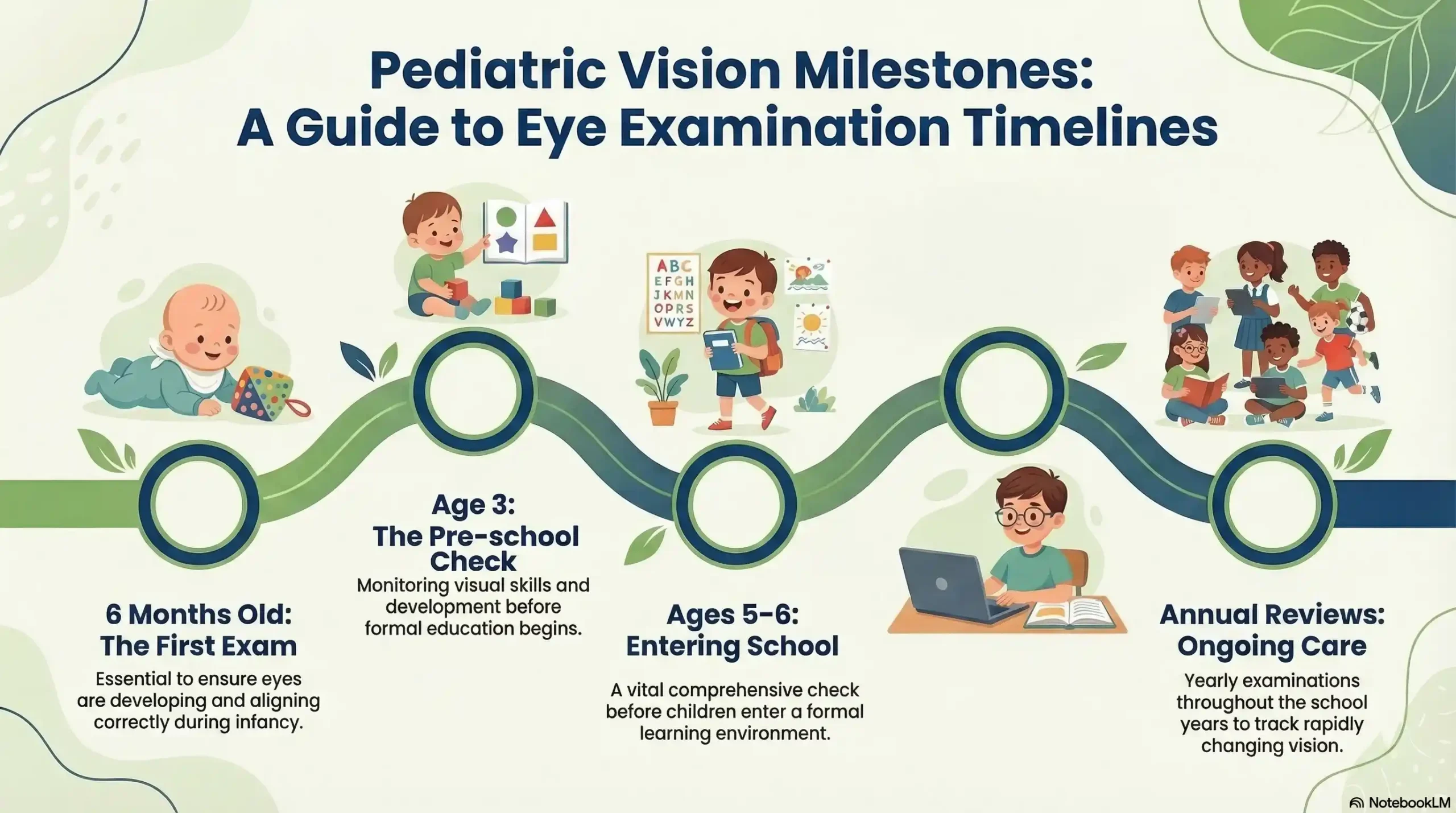
| Age / Stage | Recommended Exam | What Is Evaluated |
|---|---|---|
| 6–12 Months | First comprehensive infant eye exam | Eye alignment, early detection of refractive errors, and eye health |
| Age 3 | Pre-school exam | Visual acuity, binocular vision, and amblyopia screening |
| Age 5–6 | Before starting school | Full assessment before critical learning years begin |
| School Age (6–18) | Every 1–2 years (annually if correction needed) | Prescription changes, myopia progression, and eye coordination |
| Any Age | Immediately, if symptoms are present | Triggered by any warning signs identified by the parent or teacher |
The AOA recommends that children receive their first comprehensive eye exam at 6 months of age, followed by exams at age 3, before starting school, and annually thereafter — particularly during the school years when vision demands are highest.
The earlier a vision problem is identified, the wider the treatment window — and the better the long-term outcome for your child’s vision and development.
What to Expect During a Pediatric Eye Exam at Poudre Valley Eyecare
A Welcoming Experience Designed for Kids and Parents
We understand that bringing a young child to any medical appointment comes with a certain level of anticipation — for both the child and the parent. At Poudre Valley Eyecare, our approach to pediatric eye care is built on the same patient-first philosophy that has guided our practice for over 30 years: your child’s comfort and your peace of mind are our priorities.
Our exams are thorough, unhurried, and designed to be engaging for children at every age. We take the time to explain every step of the process in age-appropriate terms, ensuring your child feels at ease from the moment they walk in. We also make it a priority to keep you, the parent, fully informed — explaining our findings clearly, answering your questions completely, and providing straightforward guidance on next steps.
There are no high-pressure recommendations here. No retail sales environment. Just honest, expert clinical care focused entirely on your child’s eye health.
Advanced Technology — The Optos Optomap Difference
Poudre Valley Eyecare invests in advanced diagnostic technology because we believe your child deserves more than the minimum standard of care. Our use of the Optos Optomap system represents a significant advancement in what a pediatric eye exam can detect.
The Optomap captures an ultra-widefield image of up to 82% of the retina in a single scan — without the need for uncomfortable dilation drops in most cases. For children, this means a faster, more comfortable experience. For parents, it means greater diagnostic confidence. The Optomap’s ultra-widefield view allows our optometrists to detect early signs of retinal conditions, assess overall eye health comprehensively, and, in some cases, identify signals of systemic health concerns that extend beyond the eye itself.
This level of diagnostic depth is what separates a comprehensive eye exam from a basic vision screening — and it is the standard your child receives at every visit to our practice.
📅 Ready to schedule your child’s comprehensive eye exam?
Our team at Poudre Valley Eyecare is welcoming new patients of all ages. Give us a call or stop by — we’d love to meet your family.
📞 (970) 493-6360 📍 1820 S College Ave, Suite B, Fort Collins, CO 80525
Does Screen Time Affect Your Child’s Vision?
It is one of the most frequently asked questions in our Fort Collins exam rooms — and it deserves a straightforward, evidence-based answer.
The research on screen time and children’s vision points to two primary concerns. The first is digital eye strain, a cluster of symptoms including eye fatigue, headaches, blurred vision, and dry eyes that results from prolonged near-focus activity. Children are not immune to this; in fact, because children are less likely to recognize or report discomfort, they may push through symptoms that an adult would immediately address.
The second concern is the growing body of evidence linking reduced outdoor time — often displaced by indoor screen activity — to accelerated myopia development and progression in children. Natural daylight exposure appears to play a protective role in healthy eye development, and its reduction correlates with higher rates of childhood nearsightedness.
Practical steps Fort Collins parents can take include encouraging the 20-20-20 rule (every 20 minutes, look at something 20 feet away for 20 seconds), prioritizing outdoor time daily, and ensuring reading and screen activities occur in well-lit environments. Most importantly, if your child is a frequent screen user and has never had a comprehensive eye exam, now is the right time to schedule one.
🏛️ Local Resources & Citations
1. Colorado Department of Public Health & Environment — Child Vision Screening Program. The official state authority on Colorado’s mandated childhood vision screening requirements — useful for parents who want to understand what screenings their child is legally entitled to and where comprehensive exams fit within the state’s broader child health framework.
2. American Optometric Association — Pediatric Eye Exam Guidelines. The nationally recognized clinical authority whose evidence-based exam frequency recommendations (6 months, age 3, age 5–6, then annually) are directly cited in this article — parents can verify the guidelines independently here.
3. Colorado State University — Department of Psychology & Vision Science Resources As Fort Collins’ flagship research university, CSU’s published research on child development and visual learning reinforces the clinical importance of early vision detection for academic success — directly relevant to the article’s school performance section.
4. National Eye Institute (NEI) — National Institutes of Health (.gov) The U.S. government’s primary eye health research authority, offering clinically verified definitions and treatment guidance for amblyopia, strabismus, and myopia — the three core pediatric conditions covered in the article.
Why Fort Collins Families Trust Poudre Valley Eyecare for Their Children’s Vision
Choosing an eye care provider for your child is not a decision families make lightly — and it should not be. You are entrusting someone with one of the most precious and complex aspects of your child’s health and development. In Fort Collins and across Northern Colorado, families have been making that choice with Poudre Valley Eyecare for over 30 years.
Our practice is family-run, patient-first, and deliberately designed around a model that separates genuine clinical care from retail pressure. When you bring your child to see us, every recommendation we make is driven by one thing: what is best for your child’s long-term eye health. Our membership in the American Optometric Association, the Colorado Optometric Association, and the Northern Colorado Optometric Association reflects our ongoing commitment to clinical excellence and continuing education — because the standard of care we deliver today must always be better than the one we delivered yesterday.
We serve families across Fort Collins, Loveland, Wellington, Timnath, and Greeley, and we accept most major insurance plans, including Medicare and Medicaid, because we believe access to quality eye care should never be a barrier for any family in our community.
Your child’s vision shapes their world. We are honored to help protect it.
🌟 Poudre Valley Eyecare — Serving Fort Collins Families Since 1991.
If you have noticed any signs of a vision problem in your child — or simply want the peace of mind that comes from a thorough, expert evaluation — we are here for your family.
📞 Call us today: (970) 493-6360 📍 1820 S College Ave, Suite B, Fort Collins, CO 80525
Our Focus is You.
Frequently Asked Questions
-
Look for frequent eye rubbing, rapid blinking, standing too close to the TV, squinting, persistent head tilting, or an eye that visibly turns inward or outward.
Please note: None of the above should be considered medical advice. If you’re having any concerns about your vision, please reach out to us immediately or see your primary care provider.