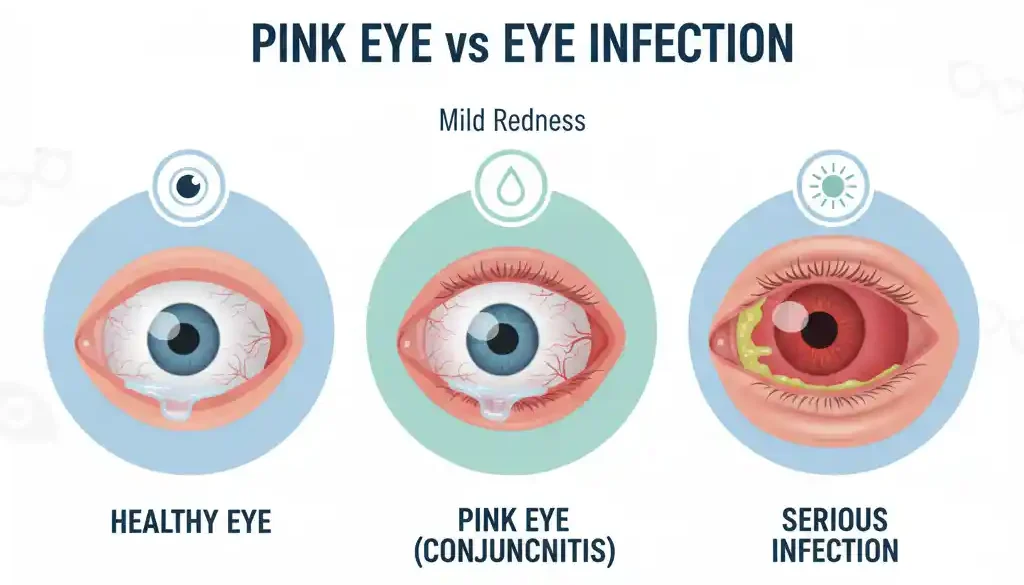
Pink Eye vs. Eye Infection: When to Get an Emergency Eye Exam
Pink eye (conjunctivitis) is a common, often contagious inflammation of the eye’s outer membrane, but not all eye infections are pink eye. While mild cases of viral or allergic conjunctivitis may resolve on their own, bacterial infections, corneal infections, and internal eye inflammation require prompt professional treatment. If you experience sudden eye pain, significant vision changes, extreme light sensitivity, or symptoms that worsen after 48 hours, you need an emergency eye exam in Fort Collins today. Call Poudre Valley Eyecare at (970) 493-6360 for same-day evaluation.
Your eye is red. It’s irritated, uncomfortable, and maybe even painful. You’re not sure if it’s pink eye, something more serious, or a full-blown eye emergency — and you’re not sure whether to wait it out, head to urgent care, or call your eye doctor right now.
You’re not alone. This is one of the most common and most stressful situations Fort Collins families face. At Poudre Valley Eyecare, we have been helping Northern Colorado patients navigate exactly these moments for over 30 years. Our goal with this guide is simple: give you the clear, honest, medically accurate information you need to make the right decision for your vision health — fast.
Because when it comes to your eyes, waiting on the wrong diagnosis isn’t just uncomfortable. It can be dangerous.
What Is Pink Eye? Understanding Conjunctivitis
“Pink eye” is the common name for conjunctivitis — an inflammation of the conjunctiva, the thin, transparent membrane that lines the inside of your eyelid and covers the white part of your eye. When this membrane becomes irritated or infected, the blood vessels within it dilate, producing that characteristic red or pink appearance.
Pink eye is extremely common, especially among school-age children, and it comes in several distinct forms. Understanding which type you or your child may have is the critical first step in knowing what to do next.
Viral Conjunctivitis
Viral conjunctivitis is the most frequently occurring form of pink eye and is often associated with the common cold or upper respiratory infections. Its hallmark symptom is a watery, clear discharge from one or both eyes, often accompanied by general redness and a gritty, uncomfortable sensation.
This form is highly contagious and spreads easily through direct contact and shared surfaces. The important thing to understand about viral conjunctivitis is that, like the common cold, it typically cannot be cured with antibiotics — it must run its natural course, usually resolving within 7 to 14 days. Supportive care, including cool compresses and preservative-free artificial tears, can help manage discomfort while your immune system does its work.
However, just because it is self-limiting does not mean it should always be left unexamined. If symptoms worsen significantly after the first 48 hours, a professional evaluation is always the right call.
Bacterial Conjunctivitis
Bacterial conjunctivitis is what many people picture when they think of classic pink eye — and for good reason. It is the form most commonly seen in children, particularly those in daycare and school settings where bacteria spread rapidly through hand-to-face contact.
The defining symptom is a thick, yellow or green discharge that often causes the eyelids to crust together overnight, making it difficult to open the eye in the morning. One or both eyes may be affected. Unlike the viral form, bacterial conjunctivitis typically requires antibiotic eye drops to resolve effectively and to prevent spreading to others.
If your child wakes up with crusted, matted eyes and thick discharge, please do not send them to school. Schedule an eye exam promptly — bacterial pink eye is one of the most common reasons Fort Collins parents call our office.
Allergic Conjunctivitis
For residents of Fort Collins and the broader Northern Colorado region, seasonal allergens are a very real and persistent challenge. Allergic conjunctivitis is triggered by environmental irritants such as pollen, dust mites, pet dander, and mold spores — all of which are prevalent across Larimer County throughout the spring and fall seasons.
Unlike its viral and bacterial counterparts, allergic conjunctivitis is not contagious. It characteristically affects both eyes simultaneously and is defined by intense itching, redness, and watery discharge. Treatment focuses on managing the allergic response, typically through antihistamine eye drops or oral antihistamines, rather than antibiotics.
If your eyes flare up seasonally and are accompanied by sneezing or nasal congestion, allergic conjunctivitis is the most likely culprit.
📞 Not sure what type of eye irritation you’re dealing with? Our Fort Collins eye doctors can help you find answers fast. Call us at (970) 493-6360 or book your exam online. Poudre Valley Eyecare — 1820 S College Ave Suite B, Fort Collins, CO 80525
Pink Eye vs. Eye Infection — What’s the Real Difference?
Here is something that surprises many patients: pink eye is technically a type of eye infection — but not all eye infections are pink eye.
Conjunctivitis affects only the outermost membrane of the eye. While it is uncomfortable and contagious, it rarely threatens long-term vision when treated appropriately. The danger arises when people assume that any red, irritated eye is simply pink eye and delay seeking care for a condition that is actually far more serious.
Several types of eye infections go beyond conjunctivitis and require immediate, specialized attention:
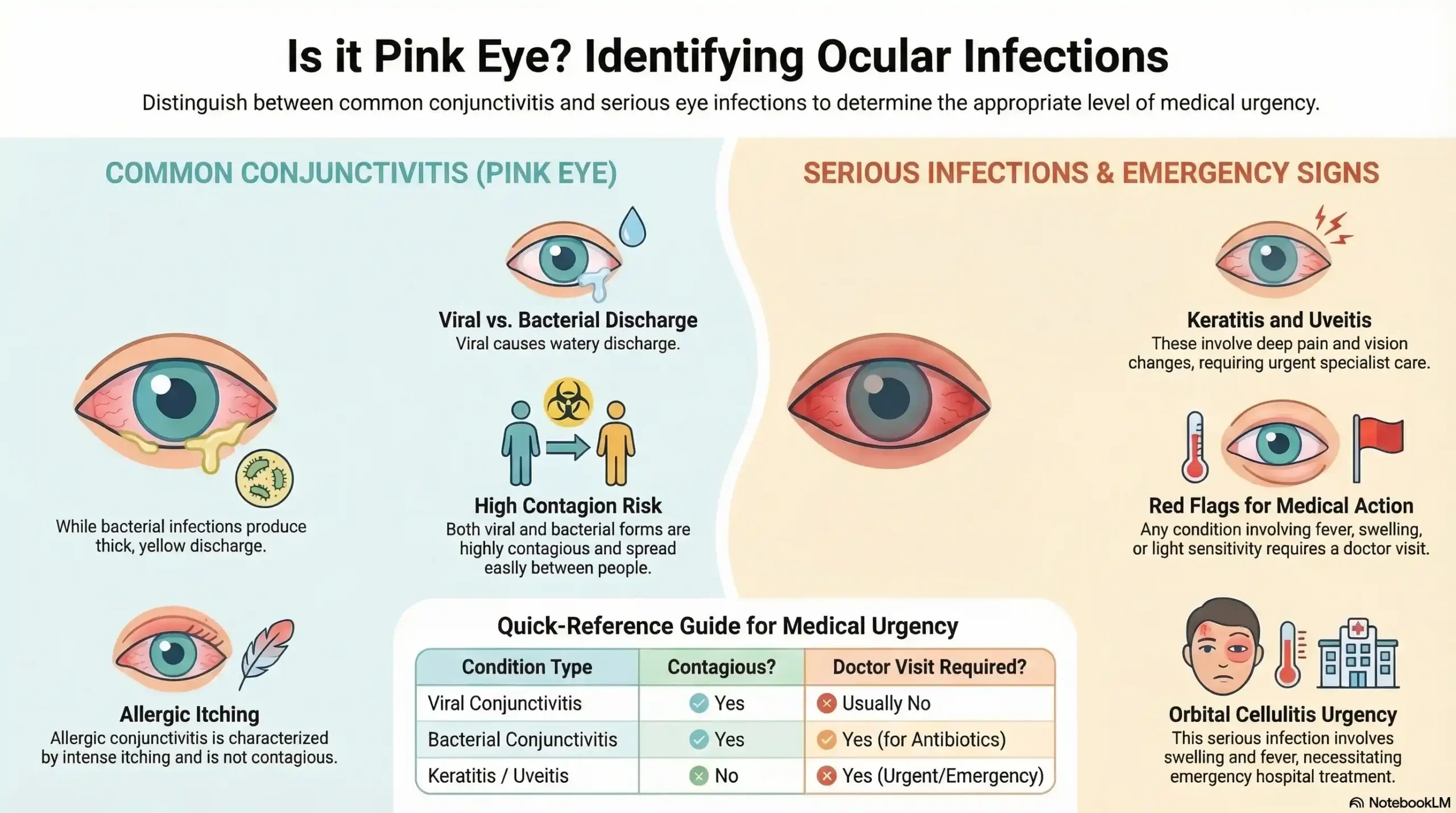
| Condition | Key Symptoms | Contagious? | Needs Eye Doctor? | Treatment |
|---|---|---|---|---|
| Viral Conjunctivitis | Watery discharge, redness, cold symptoms | Yes | Recommended | Supportive care, resolves naturally |
| Bacterial Conjunctivitis | Thick yellow/green discharge, crusting | Yes | Yes | Antibiotic eye drops |
| Allergic Conjunctivitis | Intense itching, both eyes, seasonal | No | Recommended | Antihistamines, allergy drops |
| Keratitis | Eye pain, blurred vision, light sensitivity | Varies | Yes — Urgently | Antiviral/antibiotic drops, close monitoring |
| Uveitis | Deep eye pain, light sensitivity, floaters | No | Yes — Urgently | Steroid drops, systemic treatment |
| Orbital Cellulitis | Swollen/bulging eye, fever, vision changes | No | Yes — Emergency | Immediate medical care |
Keratitis is an infection or inflammation of the cornea — the clear front surface of your eye. It is particularly common among contact lens wearers and can progress rapidly if left untreated, potentially causing permanent corneal scarring and vision loss.
Uveitis is an inflammation of the uvea, the middle layer of the eye. It can be associated with autoimmune conditions and, if not treated promptly, can result in serious, lasting damage to your vision.
Orbital cellulitis is a serious bacterial infection of the tissue surrounding the eye. It typically presents with a visibly swollen or protruding eye, fever, and pain with eye movement. This is a medical emergency requiring immediate care.
The takeaway is clear: a red eye deserves a professional evaluation, not just a trip to the drugstore.
Warning Signs — When Pink Eye Becomes an Eye Emergency
Most cases of pink eye, when properly identified and treated, resolve without long-term consequences. But certain symptoms are your eyes’ way of telling you that something more serious is happening — and those signals must never be ignored.
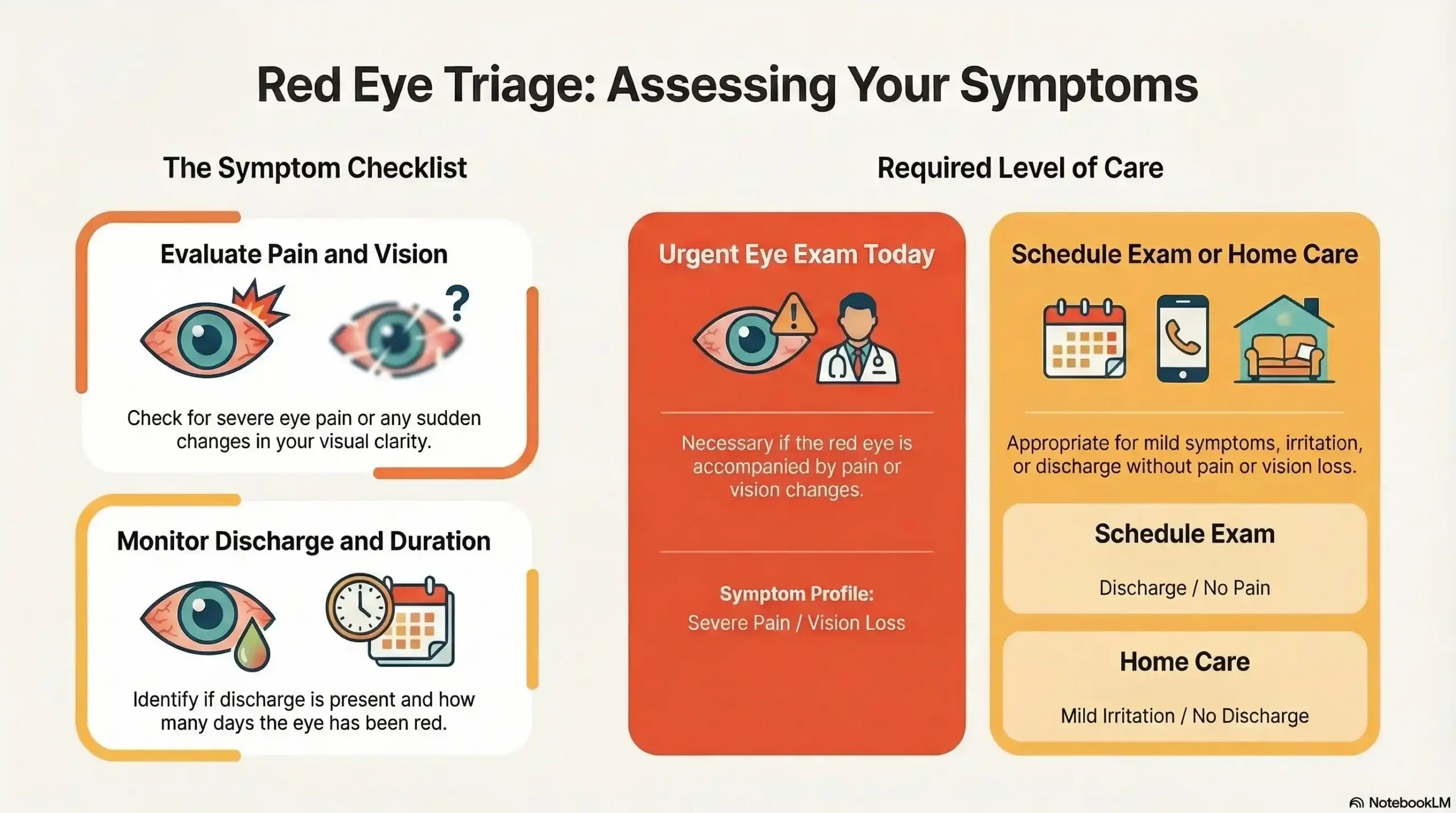
Symptoms That Require an Urgent Eye Exam Today
Please seek an immediate eye exam at Poudre Valley Eyecare or emergency care if you experience any of the following:
- Sudden or severe eye pain that is not explained by a known irritant
- Significant or rapid vision changes, including sudden blurry or double vision
- Extreme light sensitivity (photophobia) that makes it painful to be in a normally lit room
- Eye injury, including any impact, foreign body, or chemical exposure
- High fever accompanying eye symptoms, which may indicate a systemic infection
- Symptoms in a newborn or very young infant, which always warrant same-day evaluation
- No improvement after 48–72 hours, or symptoms that are actively worsening
Higher-Risk Patients Who Should Not Wait
Certain individuals face a significantly elevated risk of rapid complications and should always seek prompt professional evaluation rather than waiting to see if symptoms resolve:
Contact lens wearers are at heightened risk for keratitis, a potentially vision-threatening corneal infection that can be mistaken for routine pink eye in its early stages. If you wear contacts and develop eye pain or redness, remove your lenses immediately and call us.
Immunocompromised patients, including those undergoing chemotherapy or managing autoimmune conditions, are more vulnerable to infections escalating quickly.
Seniors with existing eye conditions such as glaucoma or macular degeneration have less margin for delay — any new symptom warrants timely professional attention.
Children under two years old should always be seen promptly for eye infections, as they cannot clearly communicate changes in their vision.
The “Wait and See” Trap — Why Delaying Care Can Be Dangerous
In our more than 30 years of serving Fort Collins families, one of the most consistent patterns we see is patients who waited too long because they assumed their symptoms were “just pink eye.”
The reality is that a corneal infection left untreated for even a few extra days can progress from minor discomfort to permanent scarring. Uveitis that goes unaddressed can lead to glaucoma, cataracts, or irreversible vision loss. These are not rare worst-case scenarios — they are documented clinical outcomes of delayed care.
At Poudre Valley Eyecare, our advanced diagnostic technology — including the Optos Optomap, which provides an ultra-widefield view of the entire retina — allows us to evaluate the health of your eye comprehensively and accurately, identifying issues that a standard examination or an urgent care visit simply cannot detect. Early detection is always the most powerful tool we have.
Should You Go to Urgent Care, the ER, or an Eye Doctor for Pink Eye?
This is one of the most important questions we hear from Fort Collins patients — and the answer has a real impact on both your outcomes and your costs.
Urgent Care can be appropriate for very mild, straightforward bacterial pink eye when an eye doctor is unavailable. However, urgent care providers are general practitioners, not eye specialists. They lack the specialized diagnostic tools to distinguish between conjunctivitis and a more serious corneal or internal eye infection. Misdiagnosis at this stage can mean incorrect treatment, delayed recovery, and escalating complications.
The Emergency Room is the right choice for true ocular emergencies: chemical burns to the eye, blunt trauma, a foreign object embedded in the eye, or sudden, complete vision loss. For anything short of these scenarios, the ER is not the most effective or efficient option — wait times are long, eye-specific expertise is limited, and costs are significantly higher.
Your Optometrist is the right first call for the vast majority of eye infections, including pink eye. A licensed optometrist has the specialized training, diagnostic equipment, and prescribing authority to accurately diagnose your condition, prescribe the correct treatment, and monitor your recovery. For Fort Collins residents, that means a same-day appointment with a doctor who knows your full eye health history.
📞 Skip the urgent care wait. Poudre Valley Eyecare offers expert eye infection evaluations in Fort Collins. Call (970) 493-6360 or book online today. Our Focus is You.
How Poudre Valley Eyecare Diagnoses and Treats Eye Infections in Fort Collins
When you come to Poudre Valley Eyecare with a red, irritated, or painful eye, you are not receiving a generic, one-size-fits-all evaluation. Every patient receives individualized, comprehensive care designed around their specific symptoms, history, and needs.
Advanced Diagnostic Technology
Our practice is equipped with the Optos Optomap, an advanced imaging system that captures an ultra-widefield view of the retina in a single, comfortable scan. This technology enables our doctors to evaluate the deepest structures of your eye — not just the surface — making it possible to detect early signs of conditions that might otherwise go unnoticed until they become significantly more serious.
The Optomap is not just an eye health tool. Its comprehensive imaging capability can also assist in identifying early indicators of systemic conditions, including certain cardiovascular risks and other diseases that first manifest in the eye. This is the kind of comprehensive, proactive care that separates a dedicated optometry practice from a retail clinic.
Comprehensive, Patient-First Exam Process
Poudre Valley Eyecare was founded on a deliberate, defining principle: patient care comes before retail. We are not an eyewear store with an exam room attached. We are a medical practice, and every decision we make reflects that commitment.
When you come in with an eye infection, your doctor will take the time to listen to your full history of symptoms, conduct a thorough slit-lamp examination, and develop a customized treatment plan tailored specifically to your diagnosis. There is no upselling. There is no rush. There is only focused, expert care delivered with genuine compassion.
We proudly accept most major insurance plans, including Medicare and Medicaid, and our team is experienced in clearly explaining your benefits so there are no surprises on your statement.
Serving All of Northern Colorado
Poudre Valley Eyecare has been a trusted part of the Fort Collins community since 1991. We serve patients throughout Northern Colorado, including Fort Collins, Loveland, Wellington, Timnath, and Greeley.
Our office is conveniently located at 1820 S College Ave Suite B, Fort Collins, CO 80525 — just off South College Avenue, one of the most accessible locations in the city for patients coming from across Larimer County.
| Symptom | Likely Condition | Recommended Action |
|---|---|---|
| Watery discharge, mild redness, no pain | Viral Conjunctivitis | Monitor 48 hours; call if worsening |
| Thick yellow/green discharge, crusting | Bacterial Conjunctivitis | Schedule eye exam promptly |
| Itching, both eyes, seasonal | Allergic Conjunctivitis | Schedule eye exam; discuss allergy drops |
| Eye pain, blurred vision, contact lens wearer | Possible Keratitis | Urgent eye exam — call today |
| Deep eye pain, light sensitivity, floaters | Possible Uveitis | Urgent eye exam — call today |
| Swollen/bulging eye, fever, vision changes | Possible Orbital Cellulitis | Emergency care immediately |
| Sudden vision loss, chemical exposure, trauma | Ocular Emergency | Go to ER immediately |
How to Prevent Pink Eye and Eye Infections
Prevention is always preferable to treatment — and most cases of infectious conjunctivitis are highly preventable with consistent, simple habits.
Hand hygiene remains the single most effective prevention tool. Washing hands thoroughly and frequently, and consciously avoiding touching your face and eyes, dramatically reduces the transmission of both viral and bacterial conjunctivitis.
Contact lens hygiene is critical for anyone who wears contacts. Always wash your hands before handling lenses, follow your replacement schedule strictly, and never sleep in lenses unless specifically prescribed for extended wear. If your eyes become red or irritated, remove your lenses immediately and switch to glasses until you have been evaluated.
Replace eye makeup regularly — mascara and eyeliner are common reservoirs for bacteria and should be replaced every three months. Never share eye makeup with others.
Keep children home during the active phase of a pink eye infection until symptoms have resolved and, in the case of bacterial conjunctivitis, until they have been on antibiotic drops for at least 24 hours.
Most importantly, schedule annual comprehensive eye exams. Regular professional evaluations allow your optometrist to monitor the long-term health of your eyes, identify changes before they become problems, and build the kind of trusted relationship that means you always have an expert to call when something does not feel right.
🏛️ LOCAL RESOURCES & CITATIONS
For: Pink Eye vs. Eye Infection | Fort Collins, CO
1. 🔴 Centers for Disease Control and Prevention (CDC) — Conjunctivitis (Pink Eye) CDC: Conjunctivitis (Pink Eye) — Official Guide The CDC’s official pink eye resource covers all causes, symptoms, treatment options, and when to seek medical care — use this to verify whether your symptoms require a doctor visit or can be managed at home.
2. 🟠 Colorado Department of Public Health and Environment (CDPHE) — Pink Eye in Schools & Child Care Settings CDPHE: Pink Eye (Conjunctivitis) — Colorado School & Child Care Guidelines Colorado’s official state health authority outlines exactly when children with pink eye should stay home from school or daycare — an essential resource for Fort Collins parents navigating school exclusion decisions.
3. 🔵 Larimer County Department of Health and Environment (.gov) Larimer County Health — Communicable Disease & Public Health The local public health authority for Fort Collins and all of Larimer County — contact them to report suspected pink eye outbreaks in classrooms or community settings, as required by Colorado state law.
4. 🟢 Colorado State University Health Network — Optometry Services (.edu) CSU Health Network: Optometry Services — Fort Collins CSU’s on-campus health network, located right here in Fort Collins at 151 W. Lake Street, provides optometry services for enrolled students — a relevant local institutional resource confirming that eye care access is a recognized campus health priority in the community.
Your Vision Is Too Important to Leave to Guesswork
A red, irritated eye can be nothing — or it can be the early sign of something that demands immediate professional attention. The difference between those two realities is not always obvious to the untrained eye, and that is precisely why the expertise of a trusted, experienced optometrist matters so much.
For more than 30 years, Poudre Valley Eyecare has been the practice Fort Collins families turn to when they need accurate answers, compassionate care, and a doctor who genuinely puts their health first. We are not a retail chain. We are not a walk-in clinic. We are your neighbors — and your dedicated eye health partners.
If your eye is red, painful, or simply not right, do not wait. Do not guess. Call us.
📞 Poudre Valley Eyecare — Fort Collins, CO Phone: (970) 493-6360 Address: 1820 S College Ave Suite B, Fort Collins, CO 80525 Schedule your appointment today. Our Focus is You.
Frequently Asked Questions
-
Pink eye (conjunctivitis) is a specific infection or inflammation of the clear membrane over your eye. Other eye infections can affect deeper structures, like the cornea, requiring different treatments.
Please note: None of the above should be considered medical advice. If you’re having any concerns about your vision, please reach out to us immediately or see your primary care provider.