When Should a Child Have Their First Eye Exam? A Parent’s Complete Guide
The American Optometric Association recommends that a child’s first comprehensive eye exam should occur at 6 months of age, followed by exams at age 3, again before starting kindergarten, and then annually throughout their school years. In Fort Collins, CO, early pediatric eye exams are especially important because many vision conditions — including amblyopia (lazy eye) and strabismus (crossed eyes) — are far more treatable when caught before age 7. A school vision screening is not a substitute for a comprehensive exam by a licensed optometrist.
Why Early Eye Exams Matter More Than Most Fort Collins Parents Realize
As a parent in Fort Collins, you do everything you can to set your child up for success — from choosing the right school to making sure they eat well and stay active. But one critical piece of your child’s health and development is often overlooked until a problem becomes impossible to ignore: their vision.
Here is the challenge. Children do not know what clear, comfortable vision is supposed to feel like. If your child has always seen the world as slightly blurry, or has always struggled to focus on a page, they have no point of comparison. They will not tell you something is wrong — because to them, nothing feels wrong. This is why professional eye exams are so essential, and why waiting for obvious symptoms can mean missing the most important treatment windows entirely.
According to the American Optometric Association, approximately 1 in 4 school-age children has a vision problem significant enough to affect their learning. In a classroom of 25 kids, that is roughly six children quietly struggling to see the board, read a book, or focus on a worksheet — often being mistaken for having attention or learning difficulties when the real issue is entirely visual.
For families throughout Fort Collins, Loveland, Wellington, Timnath, and Greeley, understanding the recommended eye exam timeline is one of the most proactive steps you can take for your child’s academic performance, confidence, and long-term eye health.
📞 Not sure if your child is due for an eye exam? The team at Poudre Valley Eyecare is here to help. We welcome patients of all ages and make children feel comfortable from the very first visit. Call us at (970) 493-6360 or schedule online today.
The Recommended Eye Exam Timeline for Children
The guidelines below are based on the recommendations of the American Optometric Association (AOA) and reflect the standard of care practiced at Poudre Valley Eyecare. Think of this timeline as your roadmap for protecting your child’s vision at every stage of development.

| Age Milestone | Recommended Exam | Primary Focus |
|---|---|---|
| 6 Months | First comprehensive infant exam | Eye alignment, tracking, focusing ability |
| Age 3 | Toddler/preschool exam | Amblyopia, strabismus, refractive errors |
| Age 5 (Pre-K) | Critical pre-school exam | School readiness, full binocular vision assessment |
| Ages 6–18 | Annual comprehensive exam | Myopia progression, digital eye strain, eye health |
Newborn to 12 Months — The First Look
Most parents are surprised to learn that a child’s first eye exam should happen before their first birthday. In fact, the AOA recommends scheduling a comprehensive infant eye exam at 6 months of age.
During this early exam, your optometrist is not simply checking whether your baby can read letters on a chart. Instead, they are evaluating the fundamental building blocks of healthy vision: whether both eyes are moving and working together properly, whether the eyes are focusing correctly, and whether any early structural concerns warrant monitoring.
In Fort Collins and across Northern Colorado, families can take advantage of the InfantSEE program — a public health initiative supported by the AOA that provides a no-cost comprehensive eye assessment for infants between 6 and 12 months of age, regardless of income or insurance status.
Early red flags to discuss with your optometrist include persistent eye crossing after 3–4 months of age, one eye that consistently turns in or out, sensitivity to light, or cloudiness in the pupil.
Ages 1–3 — Toddler Vision Milestones
The toddler years are a period of extraordinary visual development. Your child is learning to track moving objects, judge distances, coordinate their hands and eyes, and begin to process the visual complexity of the world around them.
This is also the window during which amblyopia (commonly known as lazy eye) and strabismus (misaligned or crossed eyes) most commonly present. Both conditions are highly treatable — but treatment outcomes are significantly better when intervention begins early, ideally before the age of 7 when the visual system is still neurologically flexible.
An exam between ages 1 and 3 allows your optometrist to monitor developmental milestones and catch any subtle signs of these conditions before they become harder to treat.
Ages 3–5 — The Pre-School Exam (The Most Important Window)
If there is one exam on this entire timeline that Fort Collins parents should prioritize above all others, it is the comprehensive pre-school eye exam between ages 3 and 5.
This is the single most clinically significant milestone in pediatric eye care. Here is why: amblyopia affects approximately 2–3% of the population, and if left untreated past the age of 7, the visual deficit can become permanent. The brain’s visual pathways are still forming during the preschool years, meaning that conditions like amblyopia, strabismus, and significant refractive errors — nearsightedness, farsightedness, and astigmatism — can be corrected most effectively during this window.
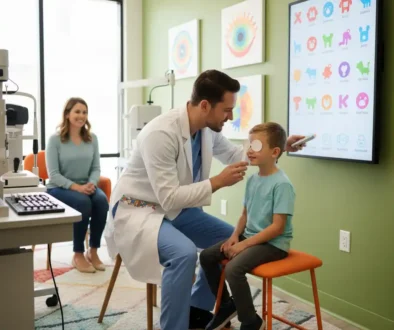
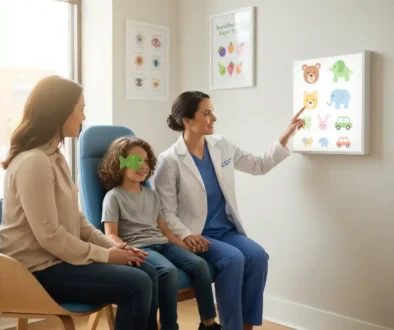
Your child does not need to be able to read letters to have a thorough eye exam. At Poudre Valley Eyecare, our optometrists are experienced in age-appropriate testing techniques that make the exam accurate, comfortable, and even enjoyable for young children.
Ages 6–18 — School-Age and Teen Vision Care
Once your child enters school, the visual demands placed on their eyes increase dramatically. Reading, writing, switching focus between a board and a desk, and now — more than ever — extended screen time on tablets and computers all place sustained stress on developing eyes.
The AOA recommends annual comprehensive eye exams for all school-age children and teenagers. This is not simply about updating a glasses prescription. Annual exams allow your Fort Collins optometrist to monitor for myopia progression — a growing concern among children globally, with screen exposure being a significant contributing factor — and to assess binocular vision, eye coordination, and overall eye health.
For teenagers approaching driving age or considering contact lenses, annual exams also serve as the foundation for those important transitions in visual care.
School Vision Screenings vs. Comprehensive Eye Exams — What Every Fort Collins Parent Needs to Know
This is perhaps the most important distinction in all of pediatric eye care, and it causes genuine confusion for many families.
What a School Vision Screening Can — and Cannot — Detect
When your child’s school conducts a vision screening, they are typically performing a single test: distance visual acuity, measured with the familiar letter chart on the wall. If your child can read the 20/20 line, they pass.
But passing a school screening does not mean your child’s vision is healthy or developing normally. School screenings cannot detect:
- Focusing problems (difficulty sustaining clear vision up close)
- Binocular vision disorders (the two eyes not working together efficiently)
- Amblyopia (lazy eye — especially when only one eye is affected)
- Convergence insufficiency (a leading cause of reading difficulty)
- Depth perception problems
- Early signs of eye disease
A child can pass a 20/20 screening and still have a vision problem significant enough to impact their reading, writing, and classroom performance.
What a Comprehensive Exam at Poudre Valley Eyecare Includes
A comprehensive pediatric eye exam at our Fort Collins practice goes far beyond the letter chart. Your child’s exam will include:
- Visual acuity testing at distance and near
- Refraction to determine the precise prescription, if any
- Binocular vision and eye coordination assessment
- Eye focusing (accommodation) testing
- Color vision screening
- Eye health evaluation using advanced diagnostic technology, including the Optos Optomap — an ultra-widefield retinal imaging system that provides a detailed view of the retina without the discomfort of traditional dilation in many cases
This thorough approach is what separates a genuine eye health evaluation from a basic screening — and it is what the team at Poudre Valley Eyecare has been providing to Fort Collins families for over 30 years.
Warning Signs Your Child May Have a Vision Problem
Because children rarely self-report vision difficulties, parents and teachers are often the first to notice behavioral clues. If you observe any of the following signs, scheduling a comprehensive eye exam promptly is strongly recommended.

| Setting | Warning Signs to Watch For |
|---|---|
| At Home | Sitting unusually close to the TV or screen |
| Frequent eye rubbing or excessive blinking | |
| Tilting the head or covering one eye to see | |
| Complaints of headaches, especially after reading | |
| Avoiding puzzles, books, or close-up activities | |
| At School | Losing their place while reading |
| Short attention span for reading or desk tasks | |
| Poor hand-eye coordination | |
| Underperforming academically despite strong effort | |
| Complaints that words “move” or “blur” on the page |
It is worth emphasizing: a child who struggles to read is not necessarily a struggling learner. In many cases, the barrier is entirely visual — and entirely correctable with the right care.
📞 Noticing any of these signs in your child? Do not wait for the next school screening. Poudre Valley Eyecare provides thorough, gentle, and child-friendly eye exams for children of all ages throughout Fort Collins and Northern Colorado. Call (970) 493-6360 or book your appointment online.
What to Expect During Your Child’s First Eye Exam at Poudre Valley Eyecare
One of the most common reasons parents delay scheduling a child’s first eye exam is uncertainty about what the experience will entail and concern that their young child will not cooperate. We want to put both concerns to rest.
Before the Appointment
Preparation is simple. Bring your insurance card and any relevant medical history, including notes about any symptoms or behaviors you have observed at home or heard from your child’s teacher. If your child currently wears glasses, bring those as well.
For younger children, it helps to talk about the appointment in a positive, low-pressure way beforehand. Let them know they will be looking at pictures and playing some eye games with the doctor. Avoid framing it as something to be nervous about — because at Poudre Valley Eyecare, there truly is nothing to be nervous about.
During the Exam
Our team understands that a child’s exam requires a completely different approach than an adult exam. Our optometrists are experienced in working with children of all ages and temperaments, using age-appropriate charts, engaging techniques, and genuine patience to make the experience comfortable and even enjoyable.
For younger children who cannot yet identify letters, we use symbol-based charts and objective testing methods that do not require verbal responses. The exam is thorough without ever feeling clinical or intimidating.
Where appropriate, we utilize the Optos Optomap technology, which captures an ultra-widefield image of the retina and allows for comprehensive evaluation of your child’s eye health, often without requiring traditional dilation drops.
After the Exam
Once the exam is complete, your optometrist will walk you through the findings in clear, straightforward language — no confusing jargon. If a prescription is needed, we will explain the options. If a condition such as amblyopia or strabismus is detected, we will discuss the recommended treatment plan, which may include glasses, patching therapy, or a referral to a specialist.
At Poudre Valley Eyecare, our commitment does not end when you leave the exam room. We are your long-term partner in your child’s visual health.
Insurance & Cost — Covering Your Child’s Eye Exam in Colorado
Concerns about cost should never stand between a child and the eye care they need. Poudre Valley Eyecare accepts most major insurance plans and is committed to making the process as transparent and stress-free as possible for Fort Collins families.
Medicaid (Colorado): Children enrolled in Colorado Medicaid (Health First Colorado) are entitled to coverage for routine eye exams and corrective lenses. Poudre Valley Eyecare accepts Medicaid, ensuring that comprehensive pediatric care is accessible to all families in our community.
CHP+ (Child Health Plan Plus): Colorado’s CHP+ program provides low-cost health coverage for children and pregnant women who do not qualify for Medicaid but cannot afford private insurance. Vision benefits are included.
Private Insurance: Most major private insurance plans include pediatric vision benefits, particularly under plans compliant with the Affordable Care Act, which mandates pediatric vision coverage as an essential health benefit.
Our team will verify your benefits before your appointment, so there are no surprises at checkout. Transparency in pricing and billing is a core part of who we are.
🏛️ Local Resources & Citations
Pediatric Eye Care | Fort Collins, CO
1. Health First Colorado — Children’s Vision Benefit Colorado’s Medicaid program covers comprehensive eye exams, standard eyeglasses, and corrective lenses for children age 20 and under through the EPSDT program — visit this page to confirm your child’s coverage before booking their appointment.
2. Poudre School District — Vision & Hearing Screenings PSD conducts vision screenings for all preschool-age children and notifies parents if their child does not pass, while encouraging families to seek a full medical evaluation since vision concerns can directly affect academic success — use this page to understand exactly what PSD screens for and what it does not.
3. Larimer County Department of Health & Environment The Larimer County Department of Health and Environment serves Fort Collins families through its offices at 1525 Blue Spruce Drive and provides community health programs, immunizations, and connections to child and family health resources throughout Northern Colorado — a reliable local hub for navigating children’s preventive health services in the Fort Collins area.
4. Colorado EPSDT Programs for Children — Medicaid Colorado’s EPSDT program mandates that all medically necessary services — including vision screenings, eye exams, and corrective treatment — be provided to enrolled children age 20 and younger, with no arbitrary service limitations allowed — reference this page if you need to verify your child’s full scope of covered eye care benefits under Colorado Medicaid.
Why Fort Collins Families Choose Poudre Valley Eyecare for Their Children
In a market with no shortage of eye care options — from large retail chains to specialty clinics — the families of Fort Collins continue to choose Poudre Valley Eyecare for one consistent reason: trust.
Since 1991, we have been a family-run practice built on genuine relationships, not retail transactions. We do not sell glasses in our office. We do not upsell. We do not rush appointments to fit in more patients. What we do is provide comprehensive, individualized eye care with the kind of personal attention that only a truly family-focused practice can offer.
Our optometrists are proud members of the American Optometric Association (AOA), the Colorado Optometric Association (COA), and the Northern Colorado Optometric Association — professional affiliations that reflect our ongoing commitment to clinical excellence and continuing education.
We serve families throughout Fort Collins, Loveland, Wellington, Timnath, and Greeley, and we welcome patients of every age — from infants on their first visit to grandparents managing chronic eye conditions. When you bring your child to Poudre Valley Eyecare, you are not just booking an appointment. You are joining a practice that will be there for your family’s vision needs for decades to come.
Our motto says it simply: Our Focus is You.
📍 Ready to schedule your child’s first eye exam? Poudre Valley Eyecare has been Fort Collins’ most trusted family eye care provider for over 30 years. Give your child the foundation of healthy, clear vision.
📞 Call us at (970) 493-6360 📍 Visit us at 1820 S College Ave, Suite B, Fort Collins, CO 80525
Schedule your child’s comprehensive eye exam today — because their future starts with what they can see.
Frequently Asked Questions
-
The American Optometric Association recommends scheduling your baby’s first eye exam between 6 and 12 months of age, even if their eyes appear completely healthy and normal.
Please note: None of the above should be considered medical advice. If you’re having any concerns about your vision, please reach out to us immediately or see your primary care provider.